7-Day Sailing Itinerary from Trogir: A Kornati & Central-Dalmatia Combo
Updated May 2026.
Trogir sits between Šibenik and Split — geographically the most-flexible charter base in Croatia. From ACI Trogir or Marina Baotić you can run north to the Kornati archipelago, south to Hvar and Vis, or stitch both onto a single 7-day route. The bay layout is calmer than Split, the airport transfer is shorter (15 minutes versus 35), and Saturday handover is less crowded. This itinerary is the realistic week most repeat charterers settle into — half north, half south, and a final loop back through the Pakleni.
Day 1 — Trogir to Maslinica, Šolta (12 NM)
Pickup at ACI Trogir or Marina Baotić by 17:00. Provision at Tommy in Trogir before pickup; Sklavenitis-style hypermarkets are sparser here than in Split, but Tommy stocks 95% of what a charter week needs. Cast off and run 12 NM south to Maslinica on Šolta’s western tip. The bay is well-sheltered from prevailing summer winds; mooring buoys (€30–60 in season) at the village’s small pontoon, or anchor in 6–9 metres on sand. Konoba Grih is the dinner reservation worth making by phone the day before. Maslinica is a calm Day-1 anchorage — short distance, simple mooring, easy departure on Day 2.
Day 2 — Maslinica to Pakleni Islands or Vis (15–25 NM)
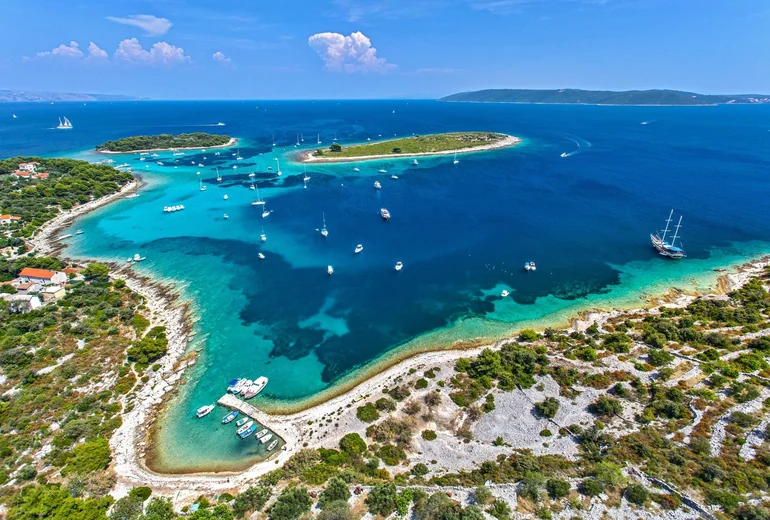
Choice day. The southbound route runs to the Pakleni archipelago off Hvar (15 NM, easier in lighter wind) or all the way to Vis (25 NM, longer but better sailing in a steady maestral). The Pakleni delivers mooring at ACI Palmižana or restaurant pontoons at Vinogradišće and Tarsce. Vis delivers a working harbour town with Konoba Roki’s (the slow-cooked-lamb reservation, taxi to Plisko Polje village). Most Trogir routes pick the Pakleni for the second night — it sits closer to a calm Day-3 with the Hvar daytime detour.
Day 3 — Pakleni to Stari Grad, Hvar (15 NM)
Loop around to Hvar’s north coast. Stari Grad bay is the deepest, most-sheltered anchorage in central Dalmatia, the village is calmer than Hvar town (still pretty, less party-leaning), and the konobe — Apolon, Antika, Kod Damira — are arguably better than the Hvar town options. Anchor in the bay or take a buoy at ACI Stari Grad. The afternoon visit into the village is one of the highlights of any Croatian week. The Hvar sailing area guide covers the island in more detail.
Day 4 — Stari Grad to Bol, Brač (12 NM)
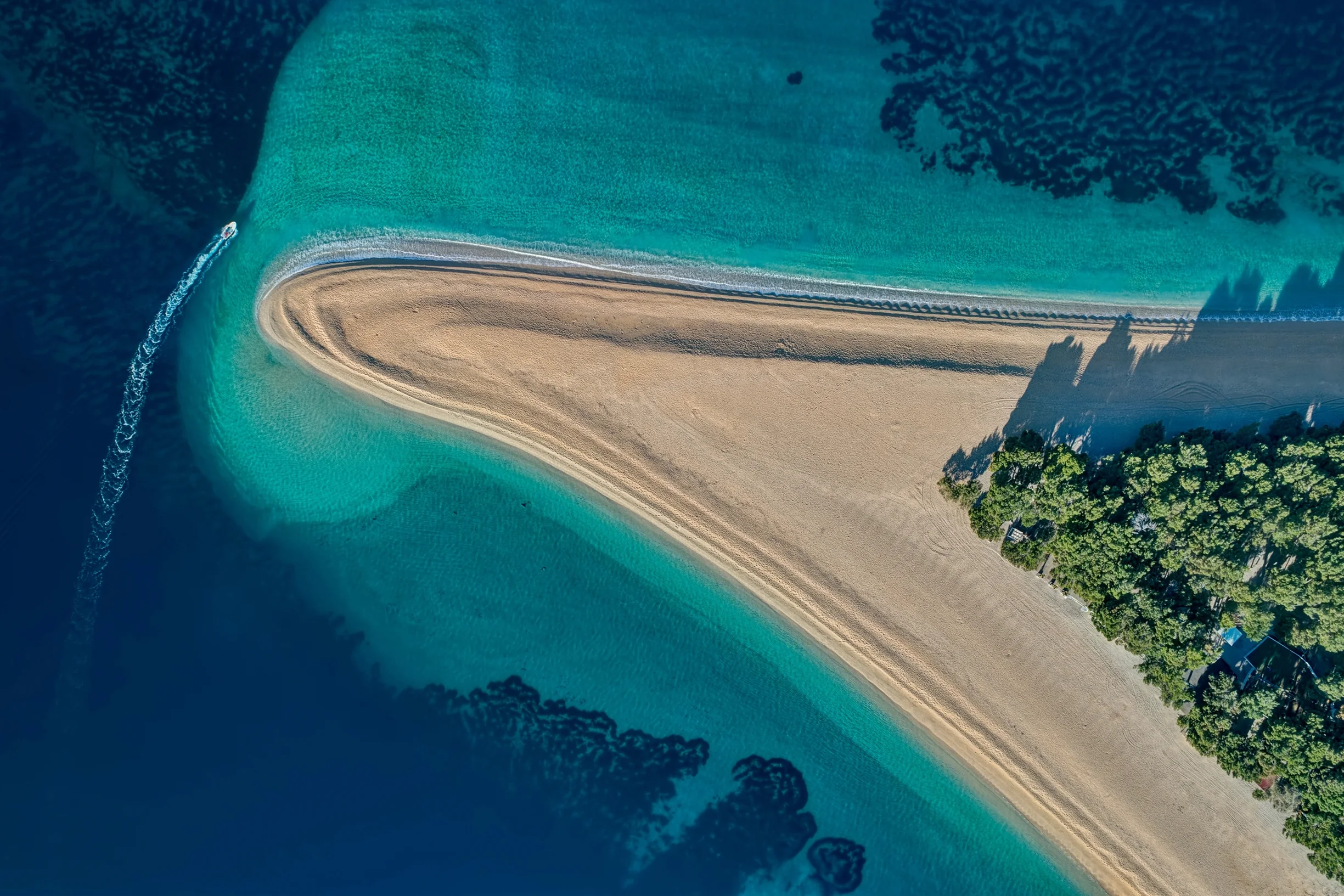
Short crossing to the south coast of Brač and the famous Zlatni Rat beach. Bol’s town quay is small and tight in season; the anchorage off Zlatni Rat works in calm weather but is exposed to the southerly. Bol town is small, walkable, and has reliable konobe (Konoba Vagonj for the working-class option, Bistro Marinero for the upmarket). If conditions favour, sleep at anchor off Zlatni Rat for the photo-album view; if conditions don’t, take a town-quay berth.
Day 5 — Bol to Vis (28 NM)
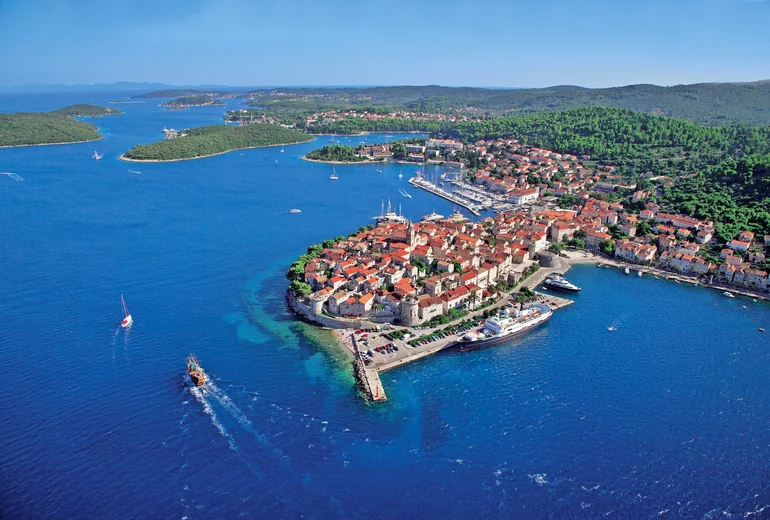
The longer west-southwest leg, mostly on a beam reach in a typical maestral. Vis is the western-most inhabited Croatian island and the prettiest single town outside Hvar and Korčula. Komiža (south coast) is the alternative pickup if Vis town is full. Both have working harbours, fuel docks, and a noticeably less-touristy feel than Hvar. Konoba Roki’s is the dinner reservation. The Stiniva cove on Vis’s south coast is the lunch-stop on the way in if conditions allow.
Day 6 — Vis to Pakleni or Trogir (25–35 NM)
Return leg. The choice is between an easy 25 NM to the Pakleni for a final calm night, or a longer 35 NM directly back to a Trogir-area anchorage (Marina Baotić is the early-arrival option). Most repeat charterers choose the Pakleni — the final night at Toto’s restaurant on Vinogradišće is a fitting close to the week, and the morning sail into Trogir on Day 7 is short. Reservations at Toto’s by phone 24 hours ahead are essential.
Day 7 — Pakleni or anchorage to Trogir (15–20 NM)
Return to ACI Trogir or Marina Baotić by 13:00 for handover. Fuel up at Marina Baotić’s fuel dock before final mooring (charter boats return with full tank). The handover team usually wants the boat clean — towels gathered, dishes done, basic tidy.
Total distances and difficulty
Roughly 120 nautical miles across the week, an average of 17 NM per day, with two longer legs (Day 5 Vis, Day 6 return). Manageable in any reasonable summer weather; the bora forecast above 25 knots in the Vis channel is a route-changer. This route is more flexible than the Split equivalent — you can shorten the southern arc and add a Kornati northbound day if conditions favour. The Split itinerary is the comparison.
The northbound alternative — adding Kornati
From Trogir you can also run north to Kornati (35 NM to Žut, 50 NM to Levrnaka in the park). A 7-day Trogir-Kornati week is operationally tight but feasible: Day 1 Trogir to Rogoznica or Primošten (15 NM). Day 2 to Žut (just outside the park, 20 NM). Day 3 into the park, Levrnaka or Piškera (15 NM). Day 4 Telašćica detour (15 NM) and back. Day 5 back to Žut, then southbound. Day 6 Šibenik or Skradin in Krka National Park. Day 7 Trogir return. The Kornati guide covers the park itself.
Provisioning, fuel and route logistics
Provisioning at Trogir is at Tommy (15 minutes’ walk from ACI Trogir) and at Konzum/Studenac in town. Fuel at Marina Baotić, ACI Split (close enough to Trogir for a transit fuel stop), Vis town, Komiža, and Bol. Marina overnights run €60–120 across the route in season; ACI Hvar and ACI Palmižana are the more expensive berths. ATMs work everywhere except Pakleni; almost every restaurant accepts cards. Budget €120–150 per crew member for week-long groceries plus dinner ashore.
Booking lead times and the Saturday-Saturday rotation
Trogir’s charter rotation is Saturday-Saturday like Split’s. Peak weeks (mid-July through mid-August) book 5–8 months ahead at Marina Baotić; ACI Trogir is similar. Shoulder weeks (June, mid-September) are 2–4 months ahead. Late-availability discounts (within 6 weeks) appear at 10–25% off list rates on unsold inventory. Trogir’s airport advantage — 15 minutes vs Split’s 35 — makes it the smart pickup for fly-in-and-go charters with limited time on Saturday.
Frequently asked questions
Is Trogir or Split the better base for a Central Dalmatia week?
Trogir for the airport advantage and calmer Saturday handover. Split for the largest fleet and most direct flights into the city. The cruising ground is the same. See the Split itinerary for the parallel route.
Can I do this route on a catamaran?
Yes — most marinas and anchorages on this route accept catamarans. Premium-marina nights cost roughly 50% more for a catamaran than a monohull. The Pakleni’s restaurant moorings handle cats fine.
How tight is parking at Marina Baotić on Saturday handover?
Less crowded than ACI Split. The marina is purpose-built for charter rotation and the team handles 80–120 boats every Saturday smoothly. Allow 90 minutes for handover plus provisioning.
Should I go north to Kornati or south to Hvar/Vis?
South for the marquee Croatian charter scenery (Hvar, Vis, Pakleni). North for Kornati’s wilder, quieter aesthetic. Most first-timers choose south; repeat charterers do the north or stitch both onto a 14-day charter.
What’s the realistic 2026 budget for a Trogir week?
For a 7-day mid-June 2026 charter on a 45-foot monohull with crew of 6: €5,800 boat + €1,500 expenses (fuel, marinas, provisioning, dinners) = ~€7,300 total, ~€1,220 per person.
The Trogir crowd — who actually charters here
Trogir attracts a slightly different charter crowd from Split. The base draws more German, Austrian, and Czech repeat charterers — crews who’ve done Split and switched to Trogir for the airport advantage and calmer Saturday handover. Italian and French markets are smaller share than Split. The fleet skews newer on average than Split’s; many Trogir-based operators run 2-4 year old boats versus Split’s 4-6 year average. Repeat charterers cite the Trogir Saturday rotation as noticeably less stressful than Split’s.
Krka National Park as a Trogir extension
Krka National Park (the inland river park north of Šibenik) is a 30-NM detour from Trogir that’s increasingly added to weekly itineraries. Sail to ACI Skradin (the gateway), take the park boat upriver to the Skradinski Buk waterfalls, walk the boardwalks, return for the night. The detour adds a Day-2 or Day-6 stop and works particularly well for crews with kids. The park entrance fee is €15-30 per person in 2026. Anchoring at Skradin is permitted in the marina basin only.
The marina-vs-anchorage rhythm on this route
The standard Trogir week splits roughly 4 marina nights and 3 anchorage nights — fewer marinas than Italian or French routes, more than Cycladic equivalents. Marina nights typically: Saturday handover at Trogir (paid for by the operator), one ACI marina (Hvar or Stari Grad), one secondary marina (Vis or Komiža), one return night near Trogir. Anchorage nights: Maslinica, Pakleni, and one wild card. Most charters use the marina nights for substantial dinners ashore and the anchorage nights for boat-cooked meals and quiet evenings. Budget-conscious crews can flip to 5 anchorage and 2 marina nights, saving roughly €350-500 across the week.
The Trogir-specific weather windows
Trogir’s slight northward position (vs Split) means the maestral hits the bay slightly stronger in mid-afternoon. Morning departures from Trogir are calm; mid-afternoon arrivals can fight 18-22 knot winds at the marina entrance. The smart pattern: depart 09:00, complete the day’s leg by 15:00, arrive at the next anchorage before the maestral peaks. Saturday morning departures from Trogir are also reliable — most weeks pickup boats at 17:00 Saturday and cast off Sunday morning, but a Saturday-evening short hop to Maslinica or another nearby anchorage is comfortable in the late maestral.
Ideas for your next sailing vacation
More than 40 countries for boat rental & yacht charter with best prices