Your search
France
389
boats available · live
500 € – 200,000 €
500 €200K €
1 – 42 guests
142
0 – 42 berths
042
14.76 – 56 m(48–184 ft)
14.76 m56 m
2000 – 2027
20002027
0 – 20 toilets
020
5 – 7,296 hp(4–5,436 kW)
5 hp7,296 hp
Prices shown are each boat's cheapest available 7-night week. Choose your dates for exact prices.
France offers something unusual in Mediterranean yacht charter: a true split personality. The Côte d'Azur glitters with islands, limestone calanques, and the gloss of Cannes. You can anchor off Porquerolles one week and explore the granite islands of Brittany the next. That range, combined with some of Europe's best anchorages and a food culture that elevates every meal, makes France an exceptional choice for both seasoned sailors and chartering newcomers.
You can browse available boats in France to explore options before committing to specific dates. Our team has helped many crews plan their charters here. This guide walks you through the actual decision points: which region suits your style, which boat type makes sense, when to go, what to budget, and what the day-to-day looks and feels like.
France wins on several counts that matter in practice. First: infrastructure. Major bases sit in Antibes, Port-Grimaud, La Ciotat, and Calvi. The ports aren't ragged—they're professionally run, well-maintained, and staffed. Second: diversity. You get genuine Mediterranean sailing in the south, the moody Atlantic in the west, and protected Brittany cruising in the north.
Third: provisioning. Every harbor has a market, a fishmonger, a wine shop, sometimes several. Restocking feels like a cultural activity rather than a logistics errand. Fourth: regulations are straightforward. French authorities maintain consistent standards for charterers. Fifth: the people. Harbormasters and local boat services tend to be direct and helpful. There's no unnecessary friction. Sixth: weather seasonality is real but manageable. Summer crowds are a real thing, but shoulder seasons (May, September) deliver warm water and empty anchorages in the same week. The mistral wind in summer can be fierce, but it clears the water to surreal clarity.
The Côte d'Azur spans roughly 140 kilometers from Saint-Tropez east to the Italian border, and it concentrates much of what Mediterranean sailing promises: sheltered islands, small towns that feel lived-in rather than theme-parked, deep water, and consistent summer winds. Saint-Tropez still draws yachts—the old harbor fills with impressive boats most evenings—but the real sailing happens in the anchorages and islands around it. Porquerolles, the largest of the Îles de Lérins, sits about 15 kilometers offshore and offers a five-kilometer sandy beach on the north shore, a small village with restaurants and a few shops, and surprisingly few crowds in June or September. The water ranges from pale turquoise in shallows to deep indigo in deeper channels.
East of Porquerolles, the route carries past Cannes and Antibes. The Îles de Lérins, right offshore from Cannes, include Sainte-Marguerite, where an old fortress watches the water, and Saint-Honorat, quieter still. Between Cannes and Antibes sits Port-Cros, another island with hiking trails and protected waters. The anchorage off the southern coast faces some swell in strong easterlies, but most of the year it's calm. Antibes itself anchors the eastern end—a working port with excellent provisioning, a medieval old town, and enough activity to keep evening interesting without feeling forced. From Antibes, sailors often run east to the Calanques, a series of limestone fjords cut deep into the coast near Marseille. The Calanques east of Marseille cut deep into white limestone cliffs—narrow fjord-like inlets where the rock glows pink at sunset and the water shifts between jade and sapphire depending on the light. Protection varies by calanque; some are rock-solid shelters, others need wind from certain quarters.
Corsica feels wilder than the mainland, and that's intentional. The island sits 80 kilometers south of mainland France, and the culture, landscape, and sailing conditions all shift noticeably. The west coast, facing the Tyrrhenian Sea, tends to be rougher; most charterers focus on the east and south. The southeastern coast around Porto-Vecchio and Bonifacio delivers some of the clearest water in the Mediterranean—visibility often exceeds 40 meters. Bonifacio, the southernmost town, sits on a clifftop with a narrow harbor entrance that looks more dramatic than it actually is. The town is tightly packed and historic, the provisioning excellent, and the anchorages around the harbor and nearby islands consistently good. The water gets deeper and colder than the Côte d'Azur; expect it to stay around 18°C even in summer.
The Scandola nature reserve, on Corsica's western coast, is protected by UNESCO and UNESCO regulations restrict where boats can anchor, but the dramatic red rhyolite cliffs and volcanic formations justify the rules. Calvi, on the northwestern coast, offers a long sandy beach, a fortified harbor, and good provisioning. The northwest coast can be exposed to winter weather and strong winds, but in summer the mistral from the northwest is less aggressive here than on the mainland Côte d'Azur. Many charterers base in Calvi for four to five days and work along the northern coast, where smaller anchorages around Île de Capraia and Îles Sanguinaires deliver fewer boats and equally good water.
Brittany feels distinctly un-Mediterranean. The coastline is granite and rocky, the villages weathered rather than glittering, the sailing more technical because tides run hard and coastal rocks require navigation attention. The Gulf of Morbihan (Mor Bihan—"small sea" in Breton) is the main cruising ground, a shallow inland sea with dozens of islands and constantly shifting sandbanks. Tidal range can exceed six meters, which means the same anchorage is a calm pond at slack water and a swift current at tide turns. The payoff: protection from Atlantic storms, beautiful granite scenery, and almost zero crowds in shoulder seasons. Belle-Île and Île de Groix are larger islands with small towns, decent provisioning, and a feeling of being at the edge of things rather than in a resort.
The climate is cooler and damper than the south. Summer water temperatures hover around 15°C, which requires a wetsuit for swimming. Wind tends to be more variable, with less of the consistent summer thermal than the Mediterranean. Many sailors come to Brittany in July and August for the warmth and light (sunset at 22:00), but the real sailing happens in May and June when the water is clearer and crowds are lighter. Tidal currents mean planning passage routes around high and low water; many cruisers hire a local skipper for their first few days to learn the rhythm.
Sailing yachts work best for the Côte d'Azur and Corsica, where consistent summer winds and open water reward going under sail. A typical Charter sailing yacht in this region runs 38-45 feet, sleeps four to six, and carries between 800 and 1200 square meters of canvas. The boat types vary: some are racer-cruisers designed to move quickly, others are more leisurely cruisers that prioritize interior space and comfort. For many sailors, the rhythm of sailing under canvas is the entire point. A sailing yacht lets you anchor in small calanques away from motor yachts and find real quiet water. Costs for a week typically run €3,500 to €7,500 depending on season and boat size.
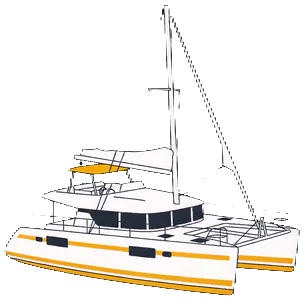
Catamarans have claimed increasing share of the charter market here, and for practical reasons: they anchor in shallower water than monohulls, provide more interior space per hull length, and deliver steadier motion in choppy conditions. Many catamarans are chartered with engine power only, which suits sailors who want to cruise without the constant small-detail management of sailing. A typical 40-foot catamaran sleeps six to eight in relatively generous cabins. Catamarans handle the Calanques particularly well because they need less depth and create less heel when anchored in rolls. Bareboat catamaran charters run €3,500 to €8,000 weekly; skippered catamaran charters with a professional crew tend to run €8,000 to €15,000 weekly depending on season.
Motor yachts make sense for charterers who want speed and flexibility but don't want the sailing overhead or the heel. Many motor yacht charterers spend more time in port enjoying restaurants and culture and less time obsessing about wind angle. A typical motor yacht for this region runs 35-50 feet and burns fuel at roughly 30-60 liters per hour depending on size and speed. The fuel cost is real, and passages between major bases can get expensive, but if your goal is to cover significant distance and spend long afternoons ashore, the efficiency argument holds. Motor yachts also handle rougher weather better than you might expect—they move through chop rather than bouncing in it. Weekly bareboat charters run €4,000 to €9,000; skippered charters run €9,000 to €16,000.
Antibes hosts one of France's largest charter fleets. The harbor itself is medieval and atmospheric—narrow lanes, small restaurants, a daily market. The base is on the edge of the old town, immediately walkable. Provisioning is excellent: Carrefour supermarket, fish markets, wine shops with serious depth. Antibes works as a base or a stopping point; many charterers position here because it's the easternmost major base and flights to Nice and neighboring airports are frequent. Wind and weather patterns make Antibes a reliable departure point most of the year, though strong easterlies can create confused seas on the passage toward the Calanques. The water off Antibes runs deep and clear; you can see the bottom at five meters depth on clear days.
Port-Grimaud sits about 20 kilometers west of Saint-Tropez and feels like an organized village built specifically for boats. The harbor is protected, provisioning is inline, and the town is walkable but not overwhelming. Many bareboat charterers choose Port-Grimaud because the harbor infrastructure removes variables from the charter experience. The tradeoff: it's less atmospheric than Antibes or a smaller village, and it feels somewhat engineered. That said, the practical advantages are real. If you're chartering for the first time, Port-Grimaud's infrastructure and nearby sailing (Porquerolles is 30 kilometers south) delivers a strong introduction.
La Ciotat sits west of Toulon, closer to the Calanques than Antibes, and hosts an active charter base. The town has maritime history—it's a working harbor, not a resort. Provisioning requires walking a bit further than Port-Grimaud, but the prices are lower and the quality of local products is high. If your interest is the Calanques and close-to-shore sailing, La Ciotat is geographically better positioned than Antibes. The harbor can be lumpy in strong mistral wind, but most summer days it's settled.
Calvi on Corsica's northern coast hosts a growing charter base. The harbor is protected by a medieval citadel, the beach is sandy and relatively long, and the old town has restaurants and shops. Flights from mainland France land in Ajaccio and Bastia; Bastia is 160 kilometers closer. The big advantage: basing in Corsica means your entire week is Corsican water—no long passages to cross between regions. The counterpoint: the Scandola coast (UNESCO reserve with dramatic cliffs) is more protected to visit from certain bases, and some routes require longer passages across deeper water than the Côte d'Azur. Most charterers do five to seven days around Corsica rather than attempting to hop between the mainland and island within a single charter week.
Seasonality in France breaks into distinct windows, each with tradeoffs. May and June deliver warm weather (average highs 20-25°C), comfortable water temperatures starting to rise, and fewer tourists than July-August. Wind tends to be lighter and more variable than July, which suits sailors who want scenic sailing rather than hard racing. Provisioning is good, restaurants are open, and many bases offer discounts on bareboat charters compared to peak season. The length of daylight is long—sunrise around 05:30, sunset around 21:00—which lets you pack more distance or more leisure into each day depending on your preference.
July and August bring peak demand and peak tourism. Harbors are crowded, anchorages fill early, and the mistral wind in the Côte d'Azur can blow hard and steady for days at a stretch. Water temperatures peak at 22-24°C, warm enough for extended swimming. If you're chartering during this window, you need flexibility: some anchorages you planned for won't have space, and you may need to anchor further from town than expected. Conversely, the weather window is most stable and the social scene in harbors is liveliest. Prices for bareboat charters can run 30-50% higher than shoulder season.
September delivers a sweet spot for many charterers: summer water warmth lingers, tourists thin noticeably, wind patterns start to become more variable rather than relentlessly consistent. Provisioning and facilities remain in full operation. Many experienced charterers consider September the best month to sail France. October gets cooler and less predictable; gales increase in frequency and some provisioning drops off. November through March is doable but cooler, wetter, and requires heavier preparation.
Charter costs break into several components: the boat cost (bareboat rental), fuel for motor boats, provisioning, harbor fees, and skippered crew if you hire one. A bareboat sailing yacht in the Côte d'Azur typically costs €3,500 to €7,500 per week depending on boat size, age, and season. Peak July-August rates run 40-60% higher. A catamaran of similar size and quality runs €4,000 to €8,500 weekly bareboat. Motor yachts follow similar pricing. These costs come down as you charter longer (two or three weeks) because the charter company discounts weekly rates for extended rentals.
Fuel for a motor yacht ranges from €200-€400 weekly depending on how much distance you cover and whether you motor or sail to maneuver. Provisioning—buying food and drink aboard—typically costs €300-€600 per person per week depending on whether you eat out frequently or cook most meals aboard. Harbor fees and mooring in paid anchorages run €30-€80 per night depending on location; small village anchorages are often free. If you hire a professional skipper, you add €150-€250 per day for salary, plus the skipper's meals and accommodations. Insurance, chart updates, and incidental services add another €200-€400 for a typical week.
A realistic full-cost estimate for a bareboat week for four people might look like this: €5,000 boat + €350 fuel + €2,000 provisioning + €350 harbor fees + €400 incidentals = €8,100, or roughly €2,000 per person. A skippered charter for the same party would run €12,000-€15,000 boat cost + fuel + provisions + €1,200 crew cost + €400 incidentals, or €4,000-€4,500 per person. These are ranges; your actual costs depend entirely on which boat, which season, and whether you anchor quietly or dine at top restaurants every night.
A bareboat charter means you rent the boat and manage it yourself. You navigate, anchor, plan routes, and handle all mechanical decisions. This works if you have sailing qualifications, a clear understanding of your own capability level, and comfort with decision-making on the water. Many bareboat charterers have sailed before or have taken sailing courses specifically for chartering. The advantage is cost (roughly half the price of a skippered charter for the same boat) and complete autonomy. The disadvantage is that you're responsible for everything, which changes the quality of your experience if something goes wrong or you're less confident than you thought.
A skippered charter brings a professional crew—typically one or two people depending on boat size and the charter structure. The skipper navigates, anchors, plans routes, and handles mechanical issues. This removes decision-making overhead from your day and lets you focus on the experience rather than the operation. The crew can also steer you to lesser-known anchorages, explain local history, and suggest restaurants because they know the area. The cost is higher, but the experience is qualitatively different. First-time charterers often find a skippered charter more relaxing; experienced sailors often prefer bareboat autonomy.
A middle path exists: some charterers hire a skipper for the first two or three days to learn local conditions, then sail independently for the balance. This typically adds €400-€600 to the cost but delivers genuine value if you're comfortable sailing but new to the specific region. Learn how we work to understand the full booking process and what to expect from start to finish.
This route combines coastal sailing with island anchorages and covers enough distance to feel like a voyage without requiring offshore passages. Most charterers find this pace comfortable for a week.
Day 1 (Base to Porquerolles): Depart Antibes or Port-Grimaud in the morning, spend 4-5 hours sailing southwest toward Porquerolles. Anchor on the north shore in Plage d'Argent or Plage de Notre-Dame depending on wind direction. The northern beaches are sandy and sheltered in most wind directions. Dinner ashore in the village; the seafood is fresh and prices are reasonable by Côte d'Azur standards. Water temperature: approximately 19°C even in peak summer.
Day 2 (Porquerolles to Îles de Lérins): Short day. Sail east toward the Îles de Lérins (roughly 40 kilometers). Anchor off Sainte-Marguerite or Saint-Honorat depending on preference. Sainte-Marguerite has the citadel and more activity; Saint-Honorat is quieter and feels less touristed. If wind is light, motorsail. Explore the fortress or the island's interior by dinghy and foot. Evening ashore or aboard.
Day 3 (Îles de Lérins to Port-Cros): Sail south around Cape d'Antibes toward Port-Cros, another island about 40 kilometers southeast. The passage can get bumpy in strong wind but is generally straightforward. Anchor in the designated anchorage on the southern coast. The island is a national park; hiking trails are excellent and uncrowded. Few restaurants on the island itself; provisioning requires planning.
Day 4 (Port-Cros to Calanques): Sail west and slightly inland toward the Calanques east of Marseille. This is a 50+ kilometer passage depending on which calanque you choose. Calanque d'En-Vau and Calanque de Sormiou are popular; Calanque de la Mola is less visited and often has space. The limestone cliffs glow pink at sunset; the water is extraordinarily clear. Small restaurants operate from beachfront cabanons (traditional huts) in some calanques. Avoid calanques on strong easterly wind days.
Day 5 (Calanques to Corsica crossing): This is the only true open-water passage of the week. Depart early morning (06:00 or earlier) from Calanques toward northern Corsica. The crossing is approximately 80 kilometers; in good conditions with sailing, you'll arrive early afternoon. Aim for Calvi or one of the anchorages near Île de Capraia on the northwestern coast. The passage can be lumpy if swell is running north-south; calm days deliver smooth water. Plan water and provisions carefully for the crossing, though it's not a long passage.
Day 6 (Corsican coast exploration): Spend the day exploring northern Corsican anchorages. Anchor off Calvi and visit the citadel and town, or anchor in the Îles Sanguinaires west of Ajaccio and explore less-visited beaches. Water clarity in Corsica exceeds the mainland Côte d'Azur; visibility often reaches 40+ meters. The wind tends to be lighter here than on the mainland.
Day 7 (Return passage): Depending on your location and energy, either return toward Port-Grimaud or Antibes (allowing 8+ hours of sailing or motorsailing), or spend the final day in a Corsican anchorage and plan to return to base the following morning. Many charterers take this approach to avoid a rushed final day.
This itinerary assumes a well-equipped bareboat and sailors comfortable with open-water passages. Skippered charters would follow a similar geographic path but with more flexibility for wind changes and crew preferences.
One significant part of French coastal chartering is the food and wine proximity. The Mediterranean coast is the origin of bouillabaisse—a fish stew thickened with saffron and aioli that originated in Marseille fishermens' kitchens. You can taste authentic versions in harbors and small restaurants throughout the Calanques and coastal towns. Tapenade, a paste of olives, capers, and anchovies, appears in nearly every market and pairs well with bread and wine before an evening sail. Rosé de Provence, the pale dry wine from vineyards inland from the coast, has become fashionable but exists on every wine list in the Côte d'Azur because it's the local product. Bandol wine from the appellation near Toulon is more serious—a structured red with aging potential and complexity that outperforms its price if you know where to look.
Markets happen multiple times per week in nearly every harbor-side town. Saint-Tropez's morning market is famous and crowded; smaller villages have equally good produce and lower prices. A week-long charter usually includes at least one or two restaurant dinners ashore, which tend to be excellent in proportion to how small the town is. The formal Michelin-starred restaurants exist in Saint-Tropez and Cannes if that's your preference, but many charterers find the best meals happen in small bistros in villages without English-language menus. Provisioning aboard means you can also cook fresh fish, local cheese, fresh bread, and prepared dishes from market vendors, which costs less and often delivers higher quality than restaurant meals.
Corsica has its own food identity: charcuterie (air-dried ham and sausages), fromage corse (a sharp cheese), and pastries with chestnut flour. Wine production is smaller than on the mainland but improving; rosé and crisp whites dominate. In Brittany, crêpes (savory and sweet) appear on nearly every menu, and calvados (an apple brandy from further inland in Normandy, but available everywhere) is the after-dinner drink of choice.
Have additional questions beyond what's covered here? Visit our complete FAQ for answers to common chartering questions.
Most bareboat charter companies require proof of sailing competence. In practice, this means either a sailing certification like an ASA or RYA qualification, or completion of a company-specific checkout where their skipper observes you sailing and confirms you can handle the boat. Some companies accept a combination of experience and a checkout. Different charter companies have different requirements, so confirm with your specific base before booking. If you're not certified and want to learn while chartering, consider a skippered charter or hire a skipper for the first few days and then take the boat independently. More detail on licences, country by country, is in our sailing licence guide.
The mistral is a strong northwesterly wind that funnels down the Rhone Valley and emerges on the Côte d'Azur. It's most common in July and August and can blow consistently at 20-30 knots for days at a stretch, with gusts exceeding 40 knots. The upside: the mistral scours the sky clear and the water stays exceptionally clear. The downside: sailing in mistral conditions requires reduced sail and careful route planning to find shelter. The Calanques can be rough on mistral days; islands like Porquerolles and Port-Cros tend to be more protected. Many charterers respect the mistral and plan to stay in harbor on extreme-wind days rather than fight conditions. Corsica, being further south, is generally less affected by strong mistral than the Côte d'Azur.
Yes, if you hire a skippered charter or hire a professional skipper for part of the week. Bareboat charters typically require demonstrated competence, but many first-time charterers take a short sailing course (2-5 days) before chartering or hire a skipper for the first few days and then take the boat independently if they feel confident. Some charter companies also offer flotilla charters where multiple boats travel together with a lead skipper and support vessel—the accountability and backup reduce risk for less-experienced charterers. Depending on your goals, a skippered charter also delivers a richer experience because the skipper knows local anchorages, hidden restaurants, and can tell you about the region.
July and August require booking two to three months in advance for popular boat types; many good boats are fully booked six months ahead. May, June, and September are easier and bookable one to two months ahead. Off-season (October, March-April) can often be booked weeks ahead. Booking early also gives you better boat selection and pricing; last-minute bookings can still work but limit options. If you're flexible on travel dates within a season, waiting until close to your trip date sometimes yields discounts as charter companies discount boats that haven't yet sold their slots.
If forecast conditions show gale-force wind or very rough seas, reputable charter companies will either postpone your charter to later dates or work with you to reschedule to dates with better forecasts. You shouldn't be pressured to sail in conditions you're uncomfortable with. In the case of small-craft advisories or strong-wind days within your charter period, you have options: stay in a protected harbor and explore ashore, ask the charter company about supplemental insurance that covers weather delays, or hire a skipper to manage the conditions. Real storms are rare in summer, but windy days are common, especially in July and August. Experienced charterers use windy days as opportunities to explore ports more thoroughly rather than resenting the wind.
For EU citizens, national ID or passport is sufficient. For non-EU citizens, a valid passport is required. For the boat itself, the charter company provides all documentation—the boat is registered, insured, and compliant with French and EU regulations. You'll receive a packet with the boat's documents, radio frequencies, emergency numbers, and area charts. Your skipper or the charter company's checklist will walk you through the process of taking possession of the boat and verifying its condition. International Certificates of Competence (ICC) or equivalent sailing certifications are sometimes requested but not typically legally required; ask your charter company what qualifications they want to see. Our FAQ lists the documents charter bases usually ask for.
France offers an unusual combination: serious sailing water with consistent wind, hundreds of protected anchorages, manageable distances between ports, outstanding provisioning, and food and wine that elevates the experience beyond just "getting around by boat."
The practical starting points are straightforward. If you want to explore the Mediterranean Côte d'Azur and Corsica, we can help you understand bareboat options or arrange a skippered charter. If you're chartering France for the first time or returning after years, we can guide you through the region, help you choose the right boat type and base for your goals, and clarify what the week looks like in concrete terms.
We know which bases deliver the best infrastructure, which areas have space in peak season, and what realistic weather and sailing conditions look like month by month. Our goal is to match you with the boat and route that fit your actual preferences and capability level, not the one that sounds most impressive or fits a postcard image.
If you're ready to explore France by boat, start by looking at our searchable catalog of available boats in France, which includes pricing, specifications, and availability calendars. If you have specific questions about whether France makes sense for your trip, or you're choosing between France and other destinations, reach out and we can walk through the decision with you. We can also explain how we work and what to expect from the booking process through delivery and return. Learn about Boat4You and why charterers trust us.
The clearest entry point is our how we work page, which walks through the booking process step by step, whatever the destination. For those wanting to understand pricing more precisely before committing, our yacht charter cost guide explains what a charter week really costs. If you want to research harbor-by-harbor rather than booking immediately, our blog covers specific regions and techniques.
France is not a destination to rush. The water, the food, the pace, and the cultural immersion work best if you give them space to happen. Whether it's a week or a month, bareboat or skippered, Côte d'Azur, Corsica or Brittany, France rewards attentive chartering.
Start by browsing available boats on the search page, or check the FAQ for common questions. New to chartering? See how the booking works.