Catamaran vs Monohull Charter: Which Boat Type Should You Pick in 2026?
Updated May 2026.
The split between catamarans and monohulls in the charter market has shifted heavily toward cats since 2020 — at most Mediterranean bases, more than 60% of new charter bookings now go to catamarans. The shift is real and the underlying reasons are real. But the catamaran is not always the right answer. This guide is the honest version: when each format wins, when each loses, and how to budget the trade-off.
The summary, before the detail
Pick a catamaran if you have 6+ adults, swim and sun-deck space matter more than sailing performance, and you can absorb a 2.5–3× higher charter rate. Pick a monohull if you have 4 sailing-focused adults, want to feel the boat sail, and prefer a tighter, lower-profile ride at half the cost. The middle case is two couples — and the answer there usually comes down to whether you sail.
Cost: the gap is real and getting wider
Like-for-like (45-foot, same week, same Mediterranean base), a modern catamaran charters at 2.5–3× the price of a comparably-sized monohull. In peak summer 2026, a 45-foot bareboat monohull from Split or Athens runs €5,000–7,500. The same-length cat at the same base sits at €13,000–18,000. Marina overnights, mooring buoys, and most haul-out fees are also more expensive on a cat — the rate of charge is per-metre, but cats are much wider than monohulls of the same length. The realistic catamaran upcharge across the full week is closer to 2.7×, not 2.5×.
Living space: the cat’s biggest win
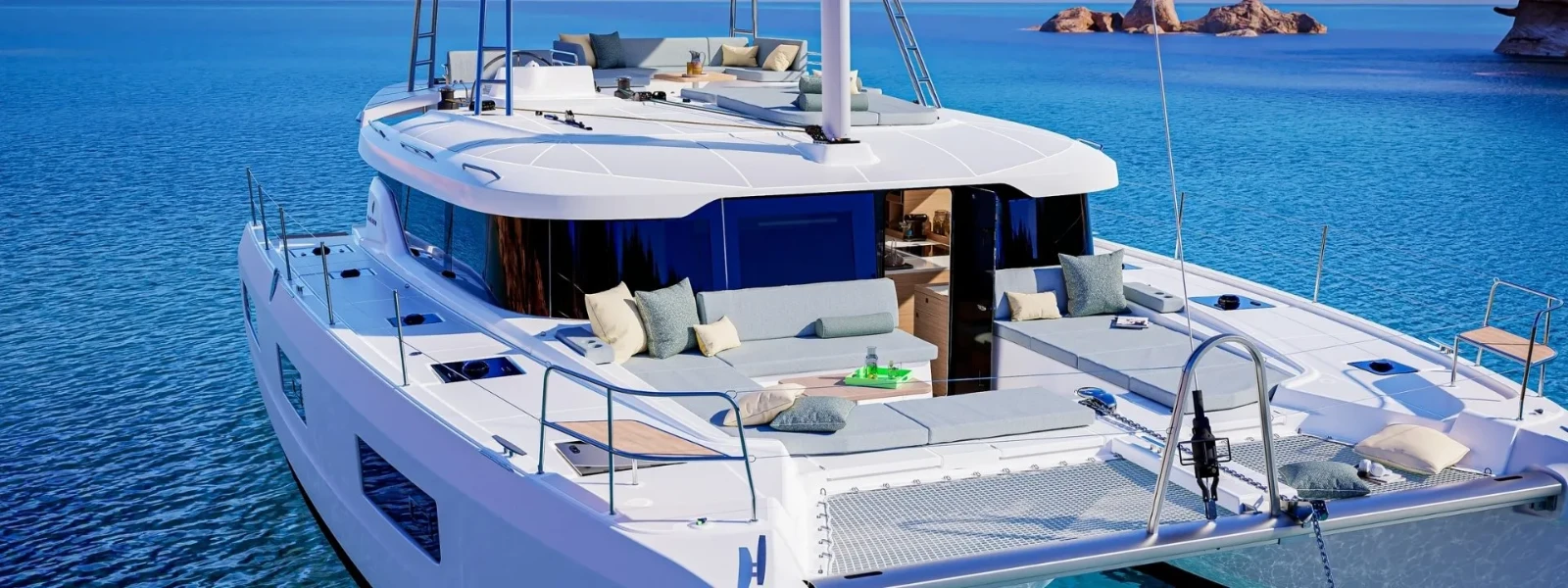
A 45-foot catamaran has roughly the volume of a 60-foot monohull. The cockpit is flat and dry. The saloon is at deck level with 360-degree visibility. The cabins are wider, the heads bigger, the storage more generous. For a charter that includes 2+ children or 6+ adults, this is decisive. Sleeping eight on a 45-foot monohull is technically possible; doing it without conflict is not.
Sailing feel: the monohull’s biggest win
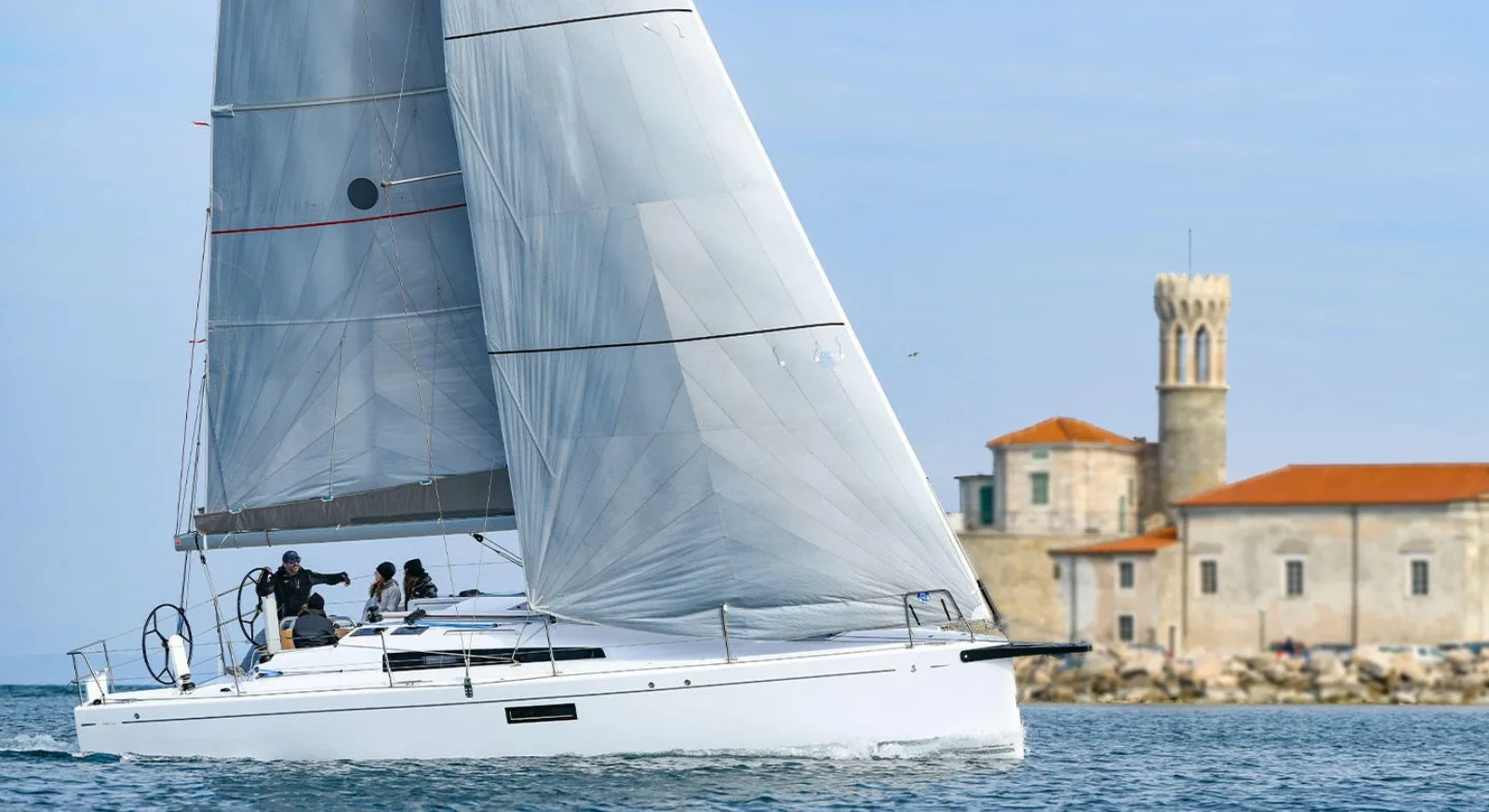
A monohull heels. A catamaran does not. A monohull responds to wind shifts and trim. A cat ploughs forward at 7–9 knots and ignores everything below 12 knots of wind. For sailing-focused crews, a charter on a catamaran is a charter on a luxury motor home with sails — it works, but it’s not sailing in the sense most experienced sailors mean. If your crew came for the sail, the monohull wins on principle and on practice.
Anchoring and shallow water
Catamarans typically draft 1.1–1.4 metres; comparable monohulls draft 1.8–2.2 metres. The half-metre matters in shallow Mediterranean coves — Mallorca’s south coast, Croatia’s Dugi Otok bays, the Cyclades’ east-facing shallow anchorages. Cats also sit flat at anchor in chop, where monohulls roll. For a swim-focused charter in shallow water, the cat is genuinely better.
Mooring and marinas: the cat’s biggest loss
Mediterranean marinas charge by metre of beam, not just length. A 45-foot cat with 7.5 metres of beam pays for two berths in many marinas. Premium marinas (Capri, Bonifacio, Porto Cervo) sometimes turn cats away outright. Stern-to mooring in tight Greek and Croatian harbours requires 2× the practice of monohull mooring — the catamaran’s twin engines help, but the wind windage is much higher. First-time bareboat skippers struggle more with cat mooring than monohull mooring.
Charter security deposit and damages
Catamaran security deposits run 30–60% higher than monohull deposits at the same base — typically €5,000–8,000 for a 45-foot cat against €3,000–5,000 for a 45-foot monohull. The most common damage on charter cats is dock contact in tight stern-to mooring; on charter monohulls it’s anchor windlass and rudder issues. Charter operators correctly price the higher cat repair costs into the deposit.
Family fit: when each wins
For families with kids under 10, the cat is almost always the right call — flat decks, big swim platforms, no heel, calm at anchor. For families with teens (mid-teens through young adults), it depends — sailing-curious teens enjoy a monohull’s heel and physicality; non-sailing teens prefer the cat’s deck space.
The format that wins by destination
— Greece (Cyclades): monohull, for the meltemi performance.
— Greece (Saronic, Ionian): cat for families, monohull for couples.
— Croatia (Central Dalmatia): split — cat increasingly dominant in family fleets.
— Italy (Amalfi, Aeolian): monohull, due to cat marina upcharges.
— Italy (Sardinia, La Maddalena): split — cats increasingly common.
— Türkiye (Gökova, Göcek): split — gulets compete for the same crew profile.
— Spain (Balearics): cat dominant in family fleets.
The budget question, answered honestly
A 45-foot catamaran charter for 8 people in peak Mediterranean season costs roughly €1,650–2,300 per person per week including all extras. The same week on a 45-foot monohull (sleeping 6 in comfort, 8 with creaking) costs €1,000–1,500 per person. The gap is real. The right question isn’t “which is better” but “is the cat worth €600–800 more per person to my crew?” For groups where the answer is yes, the cat is worth it. For groups where it’s no, monohull every time.
Frequently asked questions
Is a catamaran easier to sail than a monohull?
On the water, yes — flat, predictable, twin-engine manoeuvring. In the marina, no — bigger windage, harder stern-to mooring. Net: a draw for a competent skipper.
Can a catamaran beat a monohull upwind?
Rarely. Modern charter cats prioritise space over performance and lose 5–10 degrees of pointing angle vs comparable monohulls. Off the wind, cats are fast and stable.
What’s the average crew size on chartered cats vs monohulls in 2026?
Cats average 6–8 crew. Monohulls average 4–6. The crowd-size difference drives most of the format choice.
Are cats safer than monohulls in heavy weather?
Different, not safer. Cats don’t capsize easily but suffer worse pitching in big seas. Monohulls heel but right themselves. The reasonable answer: in charter cruising weather (under 30 knots), both are equally safe.
Should first-time bareboat skippers pick a cat or monohull?
Monohull. The mooring is simpler, the windage is lower, the financial exposure is smaller. Take a cat on your second or third charter, not your first.
The 5-year shift: why cats now dominate
Catamaran share of the charter fleet has roughly doubled since 2018 in the major Mediterranean bases. The reasons are demand-side, not supply: family-friendly chartering grew faster than couples-chartering, and families with kids universally prefer the cat. Boat builders responded — Lagoon, Bali, Fountaine Pajot and Leopard now produce more 45–50-foot charter cats per year than equivalent monohulls. Charter operators followed, and at most Croatian, Greek and Balearic bases the cat fleet now outnumbers the monohull fleet 2:1 for new boats. The shift is structural, not a fad.
Hidden costs that surprise first-time cat charterers
Beyond the headline charter rate, cats have several hidden cost lines that surprise first-time charterers. Marina overnights are charged by berth width, not just length — a 45-foot cat with 7.5m beam often pays for two berths. Mooring buoy fees in regulated areas (Cabrera, La Maddalena, the Costa Amalfitana app) sometimes have catamaran upcharges. Fuel consumption on twin-engine cats running both engines for fast crossings is 30–50% higher than equivalent monohulls. Damage deposits are 30–60% higher. Add these up and the realistic catamaran upcharge across the full week is closer to 2.7× the monohull, not the 2.5× headline figure.
The catamaran resale curve — why fleets are getting newer
Charter catamarans depreciate faster than monohulls in Mediterranean fleets — typically 12–14% per year for the first 5 years, vs 8–10% for monohulls. The reason is the rapid model evolution at Lagoon, Bali, Fountaine Pajot — newer cats add usable space, better engines, smarter helm layouts, and the older models lose value fast. For charterers, this means the catamaran fleet at major bases is consistently 0–5 years old, where the monohull fleet often runs 5–12 years old. If newness matters to you (galley appliances, sail technology, electronics), the cat fleet is structurally newer.
The middle path — sailing yachts for cat-style space
A new charter format has emerged in the past 5 years to bridge the cat-monohull gap: wide-beam performance monohulls like the Beneteau Oceanis 51.1, Jeanneau 54, Bavaria C57. These boats sleep 8–10 in 4–5 cabins, sail well, and cost 1.4–1.8× the rate of a comparable 45-foot monohull (vs 2.5–3× for a comparable 45-foot cat). For 7+ adult crews who want sailing performance and reasonable space, the wide-beam monohull is the smart middle. Availability is growing each year at most Mediterranean bases.
Descubra os barcos
Barcos para alugar nos destinos de que fala este artigo.
Ideias para suas próximas férias de navegação
Aluguel de barcos e charter de iates em todo o mundo com os melhores preços