Your search
Caribbean Islands
461
boats available · live
500 € – 200,000 €
500 €200K €
1 – 42 guests
142
0 – 42 berths
042
14.76 – 56 m(48–184 ft)
14.76 m56 m
2000 – 2028
20002028
0 – 20 toilets
020
5 – 7,296 hp(4–5,436 kW)
5 hp7,296 hp
Prices shown are each boat's cheapest available 7-night week. Choose your dates for exact prices.
The Caribbean Islands region of the Bahamas represents a distinct sailing environment: a cluster of limestone islands scattered across turquoise banks, connected by shallow passages where island-hopping culture thrives. Unlike the broader Caribbean — with its charter hubs in the Windward and Leeward Islands — the Bahamian Caribbean Islands offer an intimate, less-crowded cruising ground where pink sand beaches, protected banks, and a laid-back archipelago rhythm define the experience. This is where sailors come to escape the mainstream charter routes and discover anchorages where the water feels genuinely pristine.
The defining characteristic of the Caribbean Islands sailing area is accessibility married with isolation. Departing from Nassau, the gateway to New Providence Island, or Marsh Harbour on Great Abaco, you'll navigate a sailing ground where distances are manageable, weather patterns are predictable during the main season, and island communities maintain their maritime heritage. The shallow banks — seldom exceeding 20 feet — demand respect for draft, but they reward exploration with anchorages that monohull yachts cannot reach. Catamarans dominate this sailing area, accounting for the vast majority of charter fleet here, because their shallow draft and stability are perfectly matched to Bahamian cruising.
The Caribbean Islands region encompasses two primary island clusters. New Providence Island anchors the region with Nassau, the capital of the Bahamas and home to major charter infrastructure. Atlantis Paradise Island, Potter's Cay, and the nearby Bimini chain extend cruising options from Nassau. The island is densely developed but offers excellent provisioning, fuel, and repair facilities unavailable elsewhere in the region.
The Abacos, lying roughly 120 nautical miles northeast of Nassau, form the sailing heart of the Caribbean Islands. Marsh Harbour sits on Great Abaco as the region's second major charter hub. The Abacos comprise a dozen islands and hundreds of cays strung along the Abaco Ridge — a protective barrier that creates the sheltered Sea of Abaco, one of the Atlantic's finest cruising grounds. Hope Town on Elbow Cay is famous for its candy-striped lighthouse; the cay-filled waters between islands offer endless shallow-water anchorages; Green Turtle Cay and Guana Cay draw sailors seeking culture and isolation in equal measure.
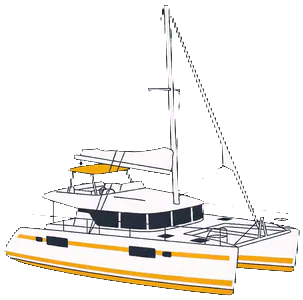
Catamarans are the default choice across this region for compelling technical and practical reasons. The Bahamas' extensive shallow banks — with water depths of 5–15 feet common in protected areas — require vessels with draft under 4 feet. Most charter catamarans draw 3–3.5 feet, accessing anchorages where traditional keeled yachts cannot venture. The wide deck beam provides comfortable cruising space during 7–14 day passages where days at anchor significantly outnumber days at sea.
Stability is equally important. While Caribbean trades blow consistently from the east-northeast, the fetch across shallow banks creates short, choppy seas that heel a monohull dramatically. Catamarans' twin hulls level the experience, keeping passengers comfortable during day transits and making the saloon genuinely usable in 3-4 knot conditions. An available fleet across Nassau and Marsh Harbour marinas gives Boat4You clients exceptional choice in this specific sailing ground.
Dual engines provide redundancy that matters in a region where service facilities are concentrated in Nassau and Marsh Harbour. Engine failure becomes manageable rather than catastrophic when you have a backup. The cargo capacity of modern catamarans — larger water tanks, wider galley, ample storage — supports 7–14 day passages with fewer marina stops, extending the sense of isolation and freedom that draws sailors to remote sailing grounds.
The Caribbean Islands sailing area lives by a distinct rhythm: early morning departures to catch the light, long anchoring intervals over afternoon hours, and evening explorations of island settlements. A typical 7-day itinerary from Nassau might follow the Exuma Bank south toward the Exuma Cays (Cat Island, Thunderball Grotto, Compass Cay) before looping back north. A 10-day charter extends east to the Eleuthera coast, offering more isolated island culture and the famous Harbour Island pink sand beach.
From Marsh Harbour, the classic route follows the Sea of Abaco, anchoring at Hope Town (Elbow Cay), exploring Green Turtle Cay and Guana Cay's remote beaches, then returning via the sheltered western banks. Longer itineraries push northeast to Great Guana Cay and the Berry Islands, accessible to catamarans willing to cross open water but offering some of the region's most pristine and least-visited anchorages.
What unifies these itineraries is the island-hopping essence: short passages (8–25 nautical miles typical), abundant all-weather anchorages, and a sailing rhythm built around snorkeling, beachcombing, and meeting local island culture rather than covering distance. This differs markedly from Mediterranean charter philosophy, where daily transit distance defines success. In the Caribbean Islands, remaining in a single anchorage for 2–3 days is the norm, not the exception.
The Bahamian Caribbean Islands experience tropical weather with distinct seasonal character. The warm season runs May through November, with peak warmth and humidity July through September. The cool season, December through April, brings trade winds stabilized from the northeast and morning temperatures of 70–75°F. Hurricane season overlaps the warm period, officially June 1 through November 30, though most major systems arrive August through October. Charter operators minimize risk by reducing winter season operations and offering aggressive discounts in May and early September when insurance costs drop and weather becomes more stable.
The best sailing season is broadly November through April, when consistent northeast trades blow 10–15 knots, temperatures are comfortable (75–80°F), and humidity is low. Within this window, April tends toward lighter winds and occasional calms, while December–February offer the most reliable consistent breeze. The shoulder months of May and September provide excellent value, with weather generally favorable despite technically remaining in the "warm" season. July and August are hot, humid, and crowded; if you're considering this period, early morning sailing and extended island anchorages make the heat manageable.
Nassau, on New Providence Island, anchors the region. Palm Cay One Marina, a gated community with modern floating docks, serves as the primary charter hub, offering 194 slips, shore power, fuel, and a private beach. Maximum draft here reaches 11.5 feet, limiting access to shallow-draft catamarans. The marina's location near Lynden Pindling International Airport (LPIA) makes flight arrivals and departures seamless — most charter clients fly in, spend one hour transferring to the marina, and depart. The town offers comprehensive provisioning, restaurants, and repair services; for regional groceries and international supplies, Nassau has no peer in the Bahamas.
Marsh Harbour, on Great Abaco, hosts the second major charter concentration. Beach Resort Marina (also known as Abaco Beach Resort & Boat Harbour Marina) operates a full-service facility with pool, chef-provisioning services, and direct resort access. TradeWinds Yacht Club represents the smaller, premium end — a fractional-ownership operation with three high-spec catamarans catering to crews seeking a more exclusive experience. Marsh Harbour International Airport connects to Nassau and the continental United States, though with fewer daily flights than LPIA. The town itself is more intimate and authentically Bahamian than Nassau; locals joke that Marsh Harbour is "where Bahamians actually live," while Nassau is tourism theater.
Both Nassau and Marsh Harbour offer fuel docks and provisioning sufficient for multi-week charters. Fresh produce, meat, and fish are available at both major marinas; beyond those points, settlements like Hope Town (Elbow Cay) and Green Turtle Cay have small grocery stores but cannot compete with Nassau's variety or pricing. Most experienced crews stock substantial fresh provisions in Nassau before departure, making the smaller island visits about experience and local specialty items rather than resupply.
Bahamian cuisine emphasizes seafood. Conch salad — raw conch marinated in lime, onion, and coconut — is the regional signature. Grouper, mahi, and crawfish appear on every island restaurant menu. Johnnycake, a cornmeal fried bread, accompanies most meals. Local Kalik beer and rum punch (particularly at weekly island gatherings called "rake and scrape" parties) define social evenings. Fresh tropical fruit — mango, papaya, coconut — is abundant in season and worth seeking at local markets.
The Bahamian Caribbean Islands region differs fundamentally from the traditional Caribbean charter grounds (Windward and Leeward Islands further south). First, island distances are shorter — a 12-25 nautical mile day is typical, versus 20-40 nautical miles typical of the Grenadines or BVI. Second, the sailing ground is less developed; restaurant and nightlife culture is virtually non-existent outside Nassau and Marsh Harbour, but genuinely pristine anchorages are abundant. Third, the banking system and provisioning infrastructure are more basic — sophisticated provisioning services offered in Grenada or St. Lucia are unavailable, requiring more self-reliance. Finally, the sheer number of catamarans and charter vessels is smaller, meaning fewer boats at anchor and greater solitude despite the region's growing popularity.
November through April offers the most reliable weather, comfortable temperatures, and consistent northeast trades. May and September provide value and generally favorable conditions, though they technically fall within hurricane season. July and August are hot and crowded; avoid them unless you have specific date constraints.
Catamarans are stable and forgiving, but bareboat charters typically require an International Certificate of Competence (ICC) or equivalent skipper certification. If you lack experience, Boat4You arranges professional skippers or offers crewed charters with full meal preparation and navigation support.
Most charter catamarans draw 3–3.5 feet, accessing the shallow banks. Monohulls drawing 5+ feet struggle with the many 6–12 foot anchorages. Typically confirm your specific vessel's draft with your charter operator before departure.
Lynden Pindling International Airport (LPIA) is the primary hub, served by most US airlines. Taxi or ride-share from LPIA to Palm Cay One Marina takes 30–45 minutes. Most charters offer pre-arranged transfers; Boat4You coordinates this seamlessly.
Yes, though it's a 120-nautical-mile passage best completed in 2 days with an overnight stop in the Abacos or Berry Islands. Many clients prefer two separate charters: one based in Nassau, one in Marsh Harbour, allowing exploration of both without the long passage.
The Caribbean Islands sailing area rewards sailors seeking intimacy, isolation, and a rhythm governed by shallow-water island exploration rather than distance. Whether you're anchoring in Hope Town's tight harbor, snorkeling in the crystalline shallows of the Exuma Cays, or watching the sun set behind an island where few tourists ever venture, the Bahamian Caribbean Islands deliver a sailing experience distinct from any other Atlantic charter ground.
Our partner network operates dedicated catamaran fleets in Nassau and Marsh Harbour, with vessels specifically configured for this sailing ground. Search our Caribbean Islands yacht charters, compare vessel layouts and pricing, or contact our team to discuss multi-week itineraries and specialized requests. Learn more about how we work or explore our story. For pre-charter planning, visit our FAQ.
Your Bahamian island-hopping adventure awaits. Boat4You makes it seamless.
Booking a yacht charter should be transparent from the first enquiry. Boat4You publishes the full price — vessel, mandatory extras, tourist tax, cleaning, transit log — before you commit. You see the boat's inventory, the operator's certifications, and the exact contract terms. No hidden surcharges. No pre-authorisations you discover only at the dock.
Our specialists speak multiple languages and know the local fleets personally. If weather changes your plans, if an item on the inventory is missing, if a port closes unexpectedly — we resolve it quickly, using real relationships built over years of cooperation with verified operators.
Most operators request 30–50% at contract signing with the balance due 4–6 weeks before departure. Exact terms appear on your quotation before you commit.
Yes — typically €2,000–€5,000 blocked on your card at check-in, released after a clean handover. A damage-waiver upgrade reduces or eliminates the hold; ask your consultant for the options on your chosen boat.
Start by browsing available boats on the search page, or check the FAQ for common questions. New to chartering? See how the booking works.