Your search
Italy
1,487
boats available · live
500 € – 200,000 €
500 €200K €
1 – 42 guests
142
0 – 42 berths
042
14.76 – 56 m(48–184 ft)
14.76 m56 m
2000 – 2027
20002027
0 – 20 toilets
020
5 – 7,296 hp(4–5,436 kW)
5 hp7,296 hp
Prices shown are each boat's cheapest available 7-night week. Choose your dates for exact prices.
Italy offers some of the world's most rewarding yacht charter destinations, combining reliable sailing conditions, dramatic coastlines, and a richness of culture that few places match. Whether you're navigating the turquoise waters around Sardinia's Costa Smeralda, exploring the steep-sided villages of the Amalfi Coast, or island-hopping through Sicily's Aeolian Islands, a yacht charter puts you in control of when to linger over lunch ashore and when to push toward the next anchorage. The Italian coast rewards slow travel. You're not constrained by flight schedules or resort timetables. You anchor where you choose, swim in hidden coves, and wake to village church bells across the water.
What makes Italy special for charter isn't just the weather or the dramatic geography. It's the combination of sophistication and informality, where a €3 espresso tastes as good as one anywhere, where locals still gather in piazzas at dusk, and where the food and wine aren't imported concepts but living traditions. This guide covers the main sailing regions, the boat types that work best, what you'll spend, and the practical details that turn a charter idea into weeks of actual sailing.
Italy presents a rare advantage for charter sailors: year-round sailing potential, protected anchorages, short distances between regions, and established charter bases. The Mediterranean here isn't a featureless blue expanse. It's layered with geography—archipelagos, peninsulas, and deep bays that create shelter and variation within a single week.
The sailing season runs longer here than in many northern regions. Summer (May through September) offers consistent thermal winds, clear visibility, and warm water. Spring and autumn see fewer crowds and often lighter but still manageable winds. Even winter—while choppier and less predictable—is feasible for experienced sailors in protected areas.
Italy's charter infrastructure is mature. You'll find professional bases with well-maintained fleets, established supply chains for provisioning, English-speaking crew for hire, and a network of marinas, anchorages, and services accumulated over decades. That means less friction and more time actually sailing.
The Amalfi Coast offers some of Europe's most photogenic scenery—pastel villages stacked impossibly high on vertical cliffs, roads that switchback into the sky, and a coastline where green mountains drop straight into deep water. Sailing here means exploring Capri, with its famous Blue Grotto and hidden eastern anchorages where the cliff walls rise 300 meters and silence is almost complete. The water around Capri shifts through shades of green and blue depending on time of day and light quality.
Ischia and Procida are working islands rather than pure tourist destinations, with local fishermen, family-run restaurants, and volcanic landscapes. Ischia's warm springs bubble offshore near Maronti Beach, and Procida's harbor is a tangle of fishing boats and pastel houses that look unchanged from the 1950s. The Amalfi base (at Salerno or directly on the coast) typically means distances of 10-25 nautical miles between major stops, making this region perfect for leisurely sailing and frequent exploring ashore.
Sardinia's northeast coast presents an entirely different Mediterranean. The Costa Smeralda—"Emerald Coast"—is named for water that really does shine emerald-green where it shallows over white sand. Granite peaks rise directly from the sea, creating dramatic anchorages and consistent afternoon thermal winds that typically come from the northwest. La Maddalena archipelago, just north, scatters seven main islands and dozens of smaller rocks across shallow water, offering the kind of protected anchorages where you can anchor off deserted beaches and see the seafloor 40 meters down.
Porto Cervo serves as the primary charter base for this region, though it carries a certain jet-set reputation and corresponding prices ashore. The sailing itself is straightforward: consistent wind, good holding in sand and mud, and short hops between islands. The islands themselves remain quieter than the main coast—Budelli Island's famous Pink Beach, created by crushed pink granite and coral fragments, attracts day sailors but few overnight visitors. Sardinia's sailing season is reliable from May through September.
The Aeolian Islands create an entirely unique sailing experience. Seven volcanic islands string out north of Sicily across 60 nautical miles of often-active water. Stromboli, still actively erupting, sends fountains of lava and stone into the air several times per hour after dark—anchor in the lee of the island and watch the orange glow from the cockpit. Lipari offers a proper harbor and supplies; Vulcano sits in the middle, with anchorages in multiple bays and hiking up to the rim of the volcanic crater. Panarea is smaller and more intimate, its nightlife concentrated along the waterfront.
These islands demand respect. The Tyrrhenian Sea between the islands can kick up quickly, with confused swells created by wind against current and by the complex bathymetry around the volcanoes. Most sailors plan passages between islands for early morning, before thermal winds build. Milazzo in Sicily serves as the main base, though some charters work out of Naples and sail down. The Aeolians work best for sailors with some experience managing variable conditions.
Tuscany's coastal sailing centers on the Tuscan Archipelago, with Elba as the largest island. Elba's 147 square kilometers contain everything from granite cliffs to long beaches, fishing villages that haven't gentrified into theme parks, and anchorages on both the eastern and western coasts. The eastern side tends to be more sheltered; the western coast receives the stronger winds and bigger swells but offers more interesting sailing. Portoferraio, Elba's main port, was Napoleon's home during his exile and retains narrow streets and authentic harbor-side atmosphere.
The smaller islands—Pianosa, Montecristo, Capraia—offer quieter exploring and the feeling of stepping back several decades. Distances are short (15-30 nautical miles between major stops), making this region ideal for sailors wanting scenic variety without long passages. The sailing season here is similar to the mainland: best May through September, with spring and autumn as calmer alternatives.
Liguria's northwest coast is steeper and rockier than the south, with the Apennines coming right down to the water. Portofino itself—a crescent harbor ringed by tall pastel buildings—is one of the Mediterranean's iconic images, though getting an anchorage in the harbor itself requires luck or reservation. The coast north toward Genoa has fewer tourists but excellent sailing. The Cinque Terre, a UNESCO site of five clifftop villages, offers dramatic coastline scenery, though these villages are best visited by hiking the trails than by anchoring directly (the anchorages nearby can be rolly in any swell).
La Spezia, about 40 nautical miles south, serves as a practical base with good facilities and shorter distances to the better anchorages. Liguria's winds are less predictable than the southern coast, with more northwesterlies and occasional föhn winds descending from the mountains. Late spring and early autumn are better times here than the height of summer.
The Adriatic coast presents a different sailing character—typically flatter, less dramatic coastal scenery, but reliable winds and well-protected anchorages. Puglia in the south, with its distinctive heel-shaped peninsula, offers shallow-water sailing, whitewashed villages, and a less touristy feel than the Mediterranean coast. The Gargano Peninsula creates a natural harbor with islands (Tremiti Islands) worth exploring.
The Venice Lagoon is sailing of a different order entirely. Shallow water, tidal ranges, and a maze of markers and channels demand local knowledge or a local pilot. Most charter yachts don't venture into the lagoon itself, but sailing to the barrier islands (Lido, Pellestrina, Chioggia) and anchoring off gives the feeling of being near Venice without the chaos of the city center. The Adriatic season runs similar to the Mediterranean—strong sailing May through September—but spring and autumn offer gentler conditions.
Sailing yachts are the classic choice for Italy, offering the full experience of catching the afternoon breeze while motoring through calm mornings. A 40-50 foot sailing yacht handles Italian waters well, with enough comfort for two to four couples and enough performance to cover ground on windy days. Bareboat sailing yachts cost typically €1,200-2,000 per week depending on season and size. They're ideal if you hold a sailing qualification and want to do the steering yourself, though hiring a professional skipper (€150-300 per day) changes the equation and lets you focus on exploring rather than helmsmanship.
The advantage of sailing yachts is the simplicity of displacement sailing through Mediterranean conditions. You're not fighting fuel costs or endlessly monitoring engine temperatures. You anchor where the wind takes you and settle in. The disadvantage is wind dependency—some weeks see more motoring than sailing, and the energy required to handle sail and lines means less energy for exploring ashore.
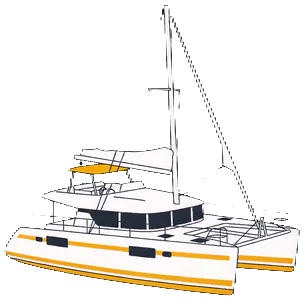
Multihulls—almost typically catamarans rather than trimarans in the charter market—offer stability, speed, spacious cockpits, and less heel than a monohull. In rough conditions, catamarans feel less lively but more comfortable. A 40-foot catamaran sleeps 8-10 across 4-5 cabins, compared to 6-8 on a similar-length monohull. Weekly rates run €1,600-2,600 depending on size and season. The tradeoff is that catamarans don't sail as close to the wind and feel less responsive to the helm—they're more vehicle-like than sailboat-like.
Catamarans suit groups wanting comfort and sleeping space over sailing purity. They also work well in light-wind conditions, where the wider beam and reduced heel make days comfortable. In heavy weather, their flat bottoms can create uncomfortable slamming if conditions have steep, short-period waves.
Motor yachts (also called motorboats or cruising powerboats) eliminate wind dependency entirely. You run on a schedule, go where you choose regardless of conditions, and spend minimal time motoring and maximum time anchored. They consume fuel, which adds 15-25% to operating costs, and they're noisier than sailing. A 40-50 foot motor yacht rents for €1,800-2,800 per week.
Motor yachts suit sailors prioritizing predictability and comfort over the sailing experience. They're excellent for families with young children, for people with limited sailing experience, and for charters where the destination matters far more than the means of getting there.
Gulets—traditional Turkish wooden sailing vessels—are relatively rare in Italian waters but worth mentioning. They combine the sailing character of a traditional vessel with spacious, comfortable cabins and often include a crew to handle the boat, leaving you to relax. A small gulet (12-16 meters) rents for €2,000-4,000 per week depending on season and crew arrangements. They're slower than modern yachts and less maneuverable, but they carry character and often attract experienced sailors who value the aesthetic experience.
Salerno, south of Naples, serves as the main departure point for Amalfi Coast and Gulf of Naples charters. The base sits right on the coast, with straightforward access to Capri (about 45 nautical miles away) and the Aeolian Islands (roughly 200 nautical miles, a two-day passage). Provisioning is excellent, prices are slightly less inflated than those on the coast itself, and you skip the architectural chaos of Naples proper.
Porto Cervo in Sardinia is the northeast's primary base, handling most Costa Smeralda and La Maddalena charters. The town itself caters heavily to wealthy visitors, which affects restaurant and shopping prices, but the base itself is professional and efficient. Distances from here are short: Maddalena islands are 15-30 nautical miles away, and the entire charter region is accessible within 50 nautical miles.
Milazzo, on Sicily's northern coast, is the gateway to the Aeolian Islands. It's a working port with fishing boats and local energy, less polished than Porto Cervo but more authentic. From Milazzo, Stromboli is roughly 80 nautical miles (one long day's sailing or a comfortable overnight passage), and all seven Aeolian Islands scatter within 100 nautical miles. Catania, on the southeastern coast, works as an alternative base and connects well to the same islands.
Marina di Scarlino or Follonica in Tuscany serve the Elba and Tuscan Archipelago charters. These bases offer smaller, quieter alternatives to the Mediterranean crowding. La Spezia on the Liguria border is another option for sailors wanting to explore the Cinque Terre area and northern archipelago.
Brindisi in Puglia launches Adriatic charters toward the heel of Italy and the Tremiti Islands. Venice-area bases (typically at Chioggia south of Venice) work for shallow-water Adriatic sailing and Venice Lagoon exploration.
Summer offers consistent thermal winds, warm water (23-26°C), clear visibility, and peak sunshine. Afternoon breezes typically build to 10-15 knots across most regions. The downsides are crowds—popular anchorages fill with day sailors and tourists—and peak prices. Weekly rates run 20-30% higher than shoulder seasons. If you're chartering with children or prioritizing comfort and predictability, summer is the call. If you're flexible and value solitude, you'll find better value elsewhere.
Spring winds are lighter and less predictable than summer (often 5-10 knots rather than 12-15), but the water is warmer than people expect (around 18-20°C), and crowds have not yet peaked. The sailing is gentler, the light is softer, and prices are 15-20% below summer. Vegetation is green, local restaurants are less packed with tourists, and you can anchor in spots that are swarmed in July and August. Spring suits sailors who prefer pleasant drifting to challenging winds, or experienced sailors wanting a quieter Italian sailing experience.
September typically sees lingering summer warmth and still-manageable winds; October brings cooler air, lighter winds, and occasional autumn swells, though typically not severe. Water temperatures drop to 18-22°C. Prices fall again (similar to spring), and the crowds thin considerably after mid-September. Autumn provides a middle ground—better wind than spring but gentler than summer, and fewer people sharing the anchorages.
Winter charters are feasible for experienced sailors. Conditions are less predictable, with occasional gales, rain, and colder water. However, prices drop significantly (40-50% below summer), and solitude is nearly reliable. Winter sailing in the Mediterranean requires realistic expectations about weather, comfort, and work required, but it attracts sailors seeking challenge and value.
Yacht charter pricing breaks into several categories. The weekly base rate (the boat itself) is the largest expense, but it's not the only one.
Weekly bareboat rates for a 40-foot sailing yacht run €1,200-1,800 in spring/autumn and €1,600-2,400 in summer. A 40-foot catamaran costs roughly 20-30% more. Motor yachts of similar size run €1,800-2,800. These prices are weekly, typically Thursday-to-Thursday or Friday-to-Friday.
The skipper, if you hire one rather than sailing bareboat, costs €150-300 per day. A professional skipper eliminates your navigational workload and lets you focus on enjoying the coast. If one crew member has a license and wants to do the sailing, you save the skipper cost entirely.
Fuel and provisioning are separate. Fuel in Italy runs roughly €1.20-1.50 per liter; a week of sailing typically consumes 100-200 liters of diesel for a motor yacht, less for a catamaran under sail, and almost none for a pure sailing vessel in windy conditions. Provisioning (food and water) depends entirely on what and where you eat—anywhere from €25 per person daily for self-catering from local markets to €80+ per person if you're eating ashore at established restaurants every meal.
Optimizing costs means chartering in spring or autumn rather than peak summer, choosing a smaller boat or sailing yacht over a larger motor yacht, doing some of the sailing yourself if you're qualified, and provisioning heavily from markets (Italian markets are inexpensive compared to tourist restaurants).
The choice between bareboat (you sail it) and skippered (a professional skipper handles the boat) depends on your experience level, your interest in helmsmanship, and your budget.
Bareboat requires a sailing qualification. Most charter companies accept International Certificate of Competence (ICC) or equivalent national certificates. Italy doesn't strictly require documentation for EU citizens with basic skills, but responsible charter companies will ask. If you hold a sailing certificate, bareboat charters give you full autonomy—you choose the route, pace, and stops. You're also responsible if something goes wrong.
A skippered charter means hiring a professional sailor (typically €150-300 per day) to handle navigation, docking, and emergencies. This is invaluable if you're not confident in your sailing, if you want to focus on exploring rather than helmsmanship, or if you're traveling with family and want professional oversight of safety. The skipper typically handles all boat operations; you're the crew and passengers.
A middle path exists: some skippers are available for partial weeks or specific challenging passages. You might bareboat the easier portions and hire professional help for a long passage or entry into a complicated harbor.
This itinerary works for spring or autumn sailing, with a 40-45 foot sailing yacht or catamaran, departing from Salerno.
Day 1: Salerno to Positano. A straightforward 25-nautical-mile sail south along the Amalfi Coast. Positano is a pastel village clinging to cliffs, with excellent restaurants spilling down to the water. Anchor in the small harbor (crowded in summer, peaceful otherwise) or in the bay south of town. Afternoon ashore for wandering steep streets and aperitivo at a harborside café.
Day 2: Positano to Capri. A 35-nautical-mile passage, often rough in the strait between the coast and the island but straightforward given decent wind. Anchor on Capri's eastern side in Marina Grande or continue around to the quieter southeast coast (Punta Tragara offers good holding and fewer boats). If the day permits, dinghy into the Blue Grotto in the afternoon light, though go early to avoid the tourist boats.
Day 3: Capri. Spend the full day exploring the eastern anchorages, hiking the coastal trails that ascend the cliffs, and swimming in water so clear the 20-meter bottom is visible. Restaurants range from simple to elaborate; the real food scene is on land rather than immediate to the harbor.
Day 4: Capri to Ischia. A 30-nautical-mile passage west and north. Ischia's northern coast offers several good anchorages; Lacco Ameno (the northwestern port) is less touristy than Forio and has a thermal beach where warm water bubbles from volcanic springs below the seafloor. Hike to Aragonese Castle at sunset; the fortress sits on a volcanic islet connected by causeway, and the views back toward the mainland are spectacular in golden light.
Day 5: Ischia to Procida. A short 8-nautical-mile passage. Procida's harbor is a maze of fishing boats and pastel houses, more working island than resort. The beaches are modest compared to the architectural setting, but the authenticity is genuine. Walk the island's narrow streets; buy fresh pasta from a local maker; eat at a family restaurant overlooking the harbor.
Day 6: Procida to Salerno via Paestum. A 40-nautical-mile passage that might take two days depending on wind. Stop briefly off Paestum to see the famous Greek temples (they're visible from offshore), then continue to Salerno for the final night. If time allows, explore Salerno's cathedral (housing the relics of St. Andrew) and harborside promenade.
Day 7: Return and checkout. Final morning for any last shopping or swimming, then return to base by noon or 14:00 for checkout.
This itinerary covers roughly 180 nautical miles and includes roughly four full days of sailing and two-three days anchored. The distances are deliberately short, allowing leisurely mornings and full afternoons ashore. If you prefer more sailing, substitute a longer passage to the Aeolian Islands (add 3-4 days) or the Sorrento Peninsula (add 2 days).
A charter is as much about eating as sailing. Italian coastal cuisine emphasizes seafood and local wines, with pasta alle vongole (pasta with clams) appearing regularly on menus in different regional variations. The Amalfi Coast is famous for limoncello, an intensely lemony digestivo made from lemons grown on the cliffs; a bottle costs €8-15 from local producers and is virtually mandatory cargo.
Sardinia's cuisine features malloreddus (hand-rolled pasta) and bottarga (salted fish roe), often paired with Vermentino, a crisp white wine that pairs beautifully with seafood. The Costa Smeralda has excellent restaurants, though prices are higher than the interior. In Sicily, the Aeolian Islands offer arancini (fried rice balls), fresh pasta with sea urchin, and local white wines from Salina that are worth seeking out.
Buy provisions from local markets (open typically 7:00-13:00 and 16:00-20:00) rather than tourist-facing shops. Markets offer better prices and better produce. Learn the names of a few dishes—pasta e fagioli (pasta and beans), caponata (Sicilian vegetable stew)—and you'll find them on menus. Most restaurants open for dinner after 19:00; lunch is 12:30-14:30.
Cultural experiences are woven into the sailing itself. You're not visiting museums but living within Mediterranean rhythms—early morning light on water, the sound of church bells across the harbor, the smell of oregano and salt, the social ritual of the evening passeggiata (stroll). Take time to sit in a piazza with a coffee, to swim in the afternoon, to eat slowly in the evening.
Italy requires a boating license (Patente Nautica) or equivalent international certification for bareboat charters. The International Certificate of Competence (ICC) issued in most countries is accepted. EU citizens may sail without formal documentation if they demonstrate basic competence, but reputable charter companies will ask for certification. If you don't hold a license, you can hire a skipper or complete a short training course (typically €300-600 for a 2-3 day intensive). Our FAQ lists the documents charter bases usually ask for.
Both are safe if you're appropriately experienced. Bareboat sailing is safe if you hold valid certification and are honest about your abilities. A skipper adds experienced oversight and handles emergencies, which is valuable if you're new to sailing or new to the area. Most charter accidents result from overconfidence rather than bad luck, so accurate self-assessment matters more than the skipper question itself. Our guide to bareboat versus skippered charter helps you decide how much support you need.
The weekly charter rate covers the boat, bedding, basic equipment (life jackets, safety gear, navigation equipment), and usually the first cleaning. Fuel, food, provisioning, skipper (if hired), and eating ashore are extra. Some companies charge a separate damage deposit (€1,000-3,000, refundable). Docking fees at marinas cost €20-60 per night. For a detailed breakdown, see our yacht charter cost guide.
May, September, and October offer excellent sailing with lighter winds, fewer crowds, and lower prices than summer. If you prioritize predictable wind and warmth, charter June-August, understanding that you'll pay more and share anchorages with more boats. Spring and autumn suit experienced sailors who value solitude over consistent heavy wind; summer suits families and less experienced sailors. Our FAQ covers what to pack for a week on board.
Yes, charter boats in Italy are required to carry safety equipment including life jackets for all aboard, flares, first aid kits, and fire extinguishers. Verify at check-in that the equipment is present and in good condition.
Yes, though it requires more planning than a simple week-long charter. If you're sailing from France or Greece, you'll need proper documentation (your yacht's registration, your sailing license, passport), insurance coverage, and realistic time and fuel budgets. Multi-country charters often require additional communication with the charter company about drop-off ports and any extra fees. Most charter companies prefer you stick to a single region for simplicity.
A yacht charter in Italy isn't an exotic indulgence—it's an efficient, affordable way to see the Mediterranean at your own pace. You anchor where you choose, explore villages on foot, eat at tables overlooking the harbor, and wake to light breaking over the water. The logistics (finding a boat, checking weather, planning provisioning) are straightforward once you've done them once.
Boat4You connects you with established charter companies across Italy, handling the booking and ensuring you're working with companies that maintain their fleets and support their clients. Whether you're booking a bareboat sailing yacht for a solo adventure, a skippered catamaran for a family, or anything between, you can search available Italy charters through our platform, read detailed information in how we work, and reach out to our team at boat4you.com about us with questions specific to your situation.
Don't overthink it. The experience of sailing Italian waters—the light, the food, the pace, the simplicity of life on the water—justifies the effort of planning. Review our FAQ section for additional details, and start planning your charter for the season that fits your schedule and temperament. The Mediterranean is waiting.
Start by browsing available boats on the search page, or check the FAQ for common questions. New to chartering? See how the booking works.