Your search
Olbia
65
boats available · live
500 € – 200,000 €
500 €200K €
1 – 42 guests
142
0 – 42 berths
042
14.76 – 56 m(48–184 ft)
14.76 m56 m
2000 – 2028
20002028
0 – 20 toilets
020
5 – 7,296 hp(4–5,436 kW)
5 hp7,296 hp
Your privacy
You can read more about how we protect your personal data and use cookies in our Privacy Policy.
With your consent, we and Google use cookies and similar technologies to store and access information on your device and to process personal data such as your visit to this website, your IP address and cookie identifiers. You can withdraw your consent at any time through “Cookies Settings” at the bottom of every page.
We and Google process data for:
Website analytics and visit statistics, recordings of visits to improve the website, ad measurement and remarketing, storing and accessing information on your device
Prices shown are each boat's cheapest available 7-night week. Choose your dates for exact prices.
Olbia stands as Sardinia's premier maritime gateway, home to Olbia Costa Smeralda Airport—the island's busiest international hub—and a busy charter port serving Mediterranean travellers. Boat4You offers a wide selection of modern catamarans departing from Olbia's marinas, with easy access to protected marine reserves, pristine beaches and the Gulf of Olbia. Whether you're arriving on an international flight or planning an extended Sardinian cruise, our partners' catamaran fleet is the perfect platform for coastal discovery, water sports and Mediterranean comfort.
Olbia Costa Smeralda Airport, just 5 kilometres from the city centre and marinas, is the fastest route to a Sardinian yacht holiday. In summer, flights arrive from many European cities, and a short taxi or transfer ride takes you to the charter bases. With car rental desks and transfers on hand, the move from terminal to catamaran deck takes only a few hours, maximising your time on the water.
The port city of Olbia itself has real Sardinian charm, with an old quarter of narrow streets, local fish markets and traditional restaurants serving regional specialities. Olbia's marinas offer provisioning, fuel docks, water and secure overnight berths for catamarans. The harbour is sheltered by the long Gulf of Olbia, giving good conditions for catamaran departures and returns in most weather.
The Tavolara – Punta Coda Cavallo Marine Protected Area, a few nautical miles east of Olbia, is one of the Mediterranean's best-preserved marine environments. It takes in Tavolara Island—a limestone massif rising 565 metres straight from the sea—and the smaller island of Molara, a landscape of breathtaking geological beauty. Cruising here offers the chance to see Mediterranean seabirds such as Audouin's gull, and peregrine falcons nest on Tavolara's upper cliffs.
Under water, the protected area reveals extensive Posidonia oceanica seagrass meadows and rocky reefs supporting diverse fish life. Snorkelling from your catamaran brings encounters with dusky grouper, amberjack and colourful wrasse in clear water, with visibility often above 20 metres. Local dive centres run guided dives in the protected area; anchoring and mooring follow the park's zoning rules, so check them before you go.
Isola Molara, Tavolara's smaller neighbour, offers quiet anchorages for a peaceful lunch stop or a sunrise swim. Its south-eastern side gives shelter from the north-westerly Mistral, creating calm conditions that suit catamarans. Sandy patches and clear, shallow water are ideal for paddleboarding, kayaking and family swimming, and the rocks around the island hide octopus and lobster—regular sights on snorkelling trips.
Spiaggia dello Spalmatore on Tavolara's western tip is one of the best-known stops in the area, with a long sandy spit, turquoise water and a small beach restaurant. Depths of a few metres over sand give good holding for catamarans of all sizes, and the evening silhouette of Tavolara's cliffs makes for memorable photographs. Remember that parts of the protected area are closed to anchoring.
Sardinian cuisine is one of the Mediterranean's most distinctive regional traditions, built on fresh seafood, artisanal methods and heritage recipes. Bottarga di muggine—salt-cured and dried mullet roe—is Sardinia's best-known culinary export, shaved thin over pasta or served with fresh lemon as an antipasto. Pecorino sardo, a sharp sheep's milk cheese, accompanies regional charcuterie and melts into fregola—a toasted pasta grain similar to couscous—cooked in savoury broths.
Cannonau, a robust red wine from the mountainous interior around Nuoro, is the island's flagship wine and pairs well with Sardinian seafood. Traditional restaurants in Olbia and the surrounding coastal villages serve cassola—a hearty fish soup of local fish and shellfish in a tomato broth with white wine and herbs. Malloreddus, small hand-rolled gnocchi dressed in meat ragù or seafood sauces, show generations of culinary craftsmanship. Provisioning with local specialities can be arranged on request, so your galley reflects Sardinia's culinary traditions.
Around the Gulf of Olbia the coastline ranges from pristine beaches to rocky headlands and small harbour villages. Cala Moresca, near Golfo Aranci north-east of Olbia, offers a sheltered anchorage in a granite-lined bay, with walking trails climbing to panoramic viewpoints. The village of Porto San Paolo, about 8 nautical miles south-east of Olbia opposite Tavolara, has harbourside restaurants and makes a good base for exploring the protected area.
The waters between the gulf and the Tavolara Marine Protected Area form a sheltered cruising zone, ideal for families looking for stable conditions and plenty of wildlife. Catamarans, with their shallow draft and twin-hull stability, handle the area's varied depths well, from deeper channels to shallow beach approaches where the tender can land on sandy shores. The Mistral from the north-west can blow strongly for a day or two, but typical summer days bring moderate breezes that suit crews of any experience.
Olbia's Mediterranean climate brings warm, dry summers with excellent visibility. From June to September average highs range from 26°C to 30°C, and nights rarely drop below 18°C. Summer days usually bring moderate sea breezes; when the Mistral sets in, it can blow 25 knots or more for a day or two, so plan sheltered anchorages in advance and follow the forecast.
Water temperatures in the Gulf of Olbia and around Tavolara range from about 14°C in winter to 26°C in August, inviting daily swimming, snorkelling and water sports. Long summer evenings—with sunset after 8:30 pm in June and July—leave plenty of time for a last swim at anchor. Visit our Italy catamaran search for available boats.
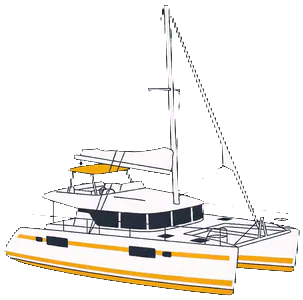
A catamaran brings clear advantages for charters from Olbia: a spacious bridge deck, twin-hull stability that reduces motion, and a shallow draft that allows beach approaches a monohull cannot make. Modern charter catamarans have generous cabins, several heads and a large galley for cooking on board. Water and fuel tanks are usually bigger than on a monohull of similar length, so you can stay out longer between marinas.
The stable platform particularly benefits families with young children, anyone prone to seasickness and travellers who want maximum comfort. Some larger catamarans carry water makers and solar panels that reduce engine running for daily electrical needs. The wide aft platform is ideal for launching paddleboards and for evening gatherings under Mediterranean stars.
Olbia Costa Smeralda Airport is only 5 kilometres from the city and its marinas, so international arrivals are quick and simple. In summer many European cities have direct flights to Olbia, which makes it ideal for travellers short on time. Boat4You can help you plan transfers; check-in and the boat handover are handled by the charter base.
Yes. A catamaran's twin-hull stability greatly reduces seasickness compared with a monohull, the large deck areas are safer for children to move around, and the shallow draft allows anchoring close to sandy beaches ideal for family swimming. With a skipper on board, the crew can also keep an eye on water safety. Many families find catamarans the better choice for a holiday afloat.
Summer weather is usually stable. A Mistral day or a rare rainy spell may change the plan, but sheltered anchorages are always within reach in the Gulf of Olbia and behind Tavolara. Books, games and a spacious saloon keep everyone comfortable while you wait for better conditions.
Catamarans draw less water (typically 1.1–1.5 metres) and can often anchor closer to the beach and in shallow bays that deeper monohulls cannot reach. Their wide beam can make very narrow passages or small harbours tighter, and marina berths for catamarans are sometimes more expensive. Pilot books and the charter base briefing will point you to the best catamaran anchorages in Sardinian waters.
It depends on the boat. Snorkelling gear is often on board, while paddleboards, kayaks and other water toys can usually be added as extras for a fee. Each boat's listing shows exactly what is included in the price and what can be booked in addition.
Cala Moresca, a secluded bay near Golfo Aranci, shows dramatic granite formations rising from turquoise water. The anchorage is protected by the surrounding headland and gives access to woodland trails that climb to viewpoints over the whole gulf. In the late afternoon the granite glows golden, perfect for photography.
Trails through Mediterranean pine and fragrant myrtle scrub connect the beach to the viewpoints above, and the local flora includes rare endemic plants. An afternoon walk fits easily before sailing on to another anchorage or harbour for the night, combining sea and land in a single day of your catamaran holiday.
Use the tender to land on the sandy beach, plan the walk with a clear time to return to the boat, and you have a balanced day that suits every member of the crew.
Olbia's marinas support catamaran charters with maintenance, provisioning and technical services. Mechanics and other technicians are available in the area if a problem needs fixing, and fuel docks and water points make refuelling straightforward.
Mobile phone coverage is good throughout the Gulf of Olbia, so staying in touch with home or work is easy if you need to. On board, batteries, refrigeration and electronics run from the boat's electrical system, charged by the engines, shore power and, on some boats, solar panels.
During your charter, the charter base team is your first contact for any technical question, and the Boat4You team is there to help before and during your trip.
Planning starts with a conversation with our charter specialists, who help with boat selection, itinerary ideas and logistics. Tell us your preferred dates, how far from Olbia you would like to cruise, any dietary needs for provisioning and the places you would most like to see. Whether you are planning a romantic escape, a family holiday with lots of water sports or a trip with friends, we help you shape every detail.
Charter prices cover the boat and its standard insurance; a skipper, fuel, provisioning, end cleaning and marina fees away from the base are usually extra, and each offer lists exactly what is included. Longer charters often come with a lower price per day. Discover your ideal Olbia catamaran charter options. Learn more at how we work and read about us at about us.
Start by browsing available boats on the search page, or check the FAQ for common questions. New to chartering? See how the booking works.
Updated November 9, 2026
Cheapest month: November 2027. Most expensive month: July 2027.
| Month | Typical week | Middle half of weeks |
|---|---|---|
| Mar 2027 | 3,129 € | 2,095 € – 5,980 € |
| Apr 2027 | 4,645 € | 3,010 € – 7,765 € |
| May 2027 | 6,462 € | 4,671 € – 8,934 € |
| Jun 2027 | 9,533 € | 7,542 € – 11,760 € |
| Jul 2027 | 12,368 € | 9,230 € – 15,674 € |
| Aug 2027 | 12,047 € | 9,140 € – 15,599 € |
| Sep 2027 | 8,304 € | 6,392 € – 10,953 € |
| Oct 2027 | 5,391 € | 3,504 € – 8,834 € |
| Nov 2027 | 2,980 € | 2,069 € – 5,860 € |
Computed every night from the 7-night charter offers of the next 12 months for the boats based here. Prices are for the boat per charter week; skipper, extras and deposit are separate, and figures based on fewer than 5 boats or offers are left out. Amounts in euros (EUR).