Charter Payment Schedules Explained: 50/50 or 25/25/50 — When Your Money Actually Leaves

Book a yacht charter and the question that nags most people isn’t the headline price — it’s when the money actually leaves their account. A yacht charter payment schedule is rarely a single lump sum. It’s a sequence: a deposit to lock the boat, a balance before you sail, and a refundable security deposit handed over at check-in. Knowing the timing matters as much as knowing the total, because each stage carries a different cancellation cost.
The two patterns you’ll meet again and again are 50/50 and 25/25/50. They look similar on a quote, but they spread your cash and your risk very differently. Below is how each one really works, where the dates fall, and what happens to your money if plans change.
What a yacht charter payment schedule actually covers
Three separate sums hide behind one booking. First, the charter fee — the rent for the boat itself, which is what the payment schedule splits up. Second, the obligatory extras paid locally: tourist tax, final cleaning, fuel, sometimes transit log or marina permits, often a few hundred euros on a mid-size catamaran. Third, the security deposit, which is not income for anyone — it’s a hold against damage, returned in full if you bring the boat back in one piece.
That third pot trips people up. A 50/50 schedule describes only the charter fee. The deposit sits on top, blocked on a card at check-in and released a few days after a clean return. On a 45-foot catamaran in Croatia or Greece you’re typically looking at €2,000–4,000 held, or a non-refundable damage waiver of roughly €25–50 a day instead. We unpack both routes in our 2026 full breakdown of yacht charter costs, but the short version: budget for the deposit as cash you can spare for two weeks, even though you expect it back.
The standard 50/50 split: deposit now, balance before you sail
This is the workhorse of the Mediterranean. You pay half the charter fee to confirm — that turns a held boat into a booked one — and the remaining half about four to six weeks before check-in. Most Croatian and Greek operators want the balance 30 days out; a handful ask for 45.
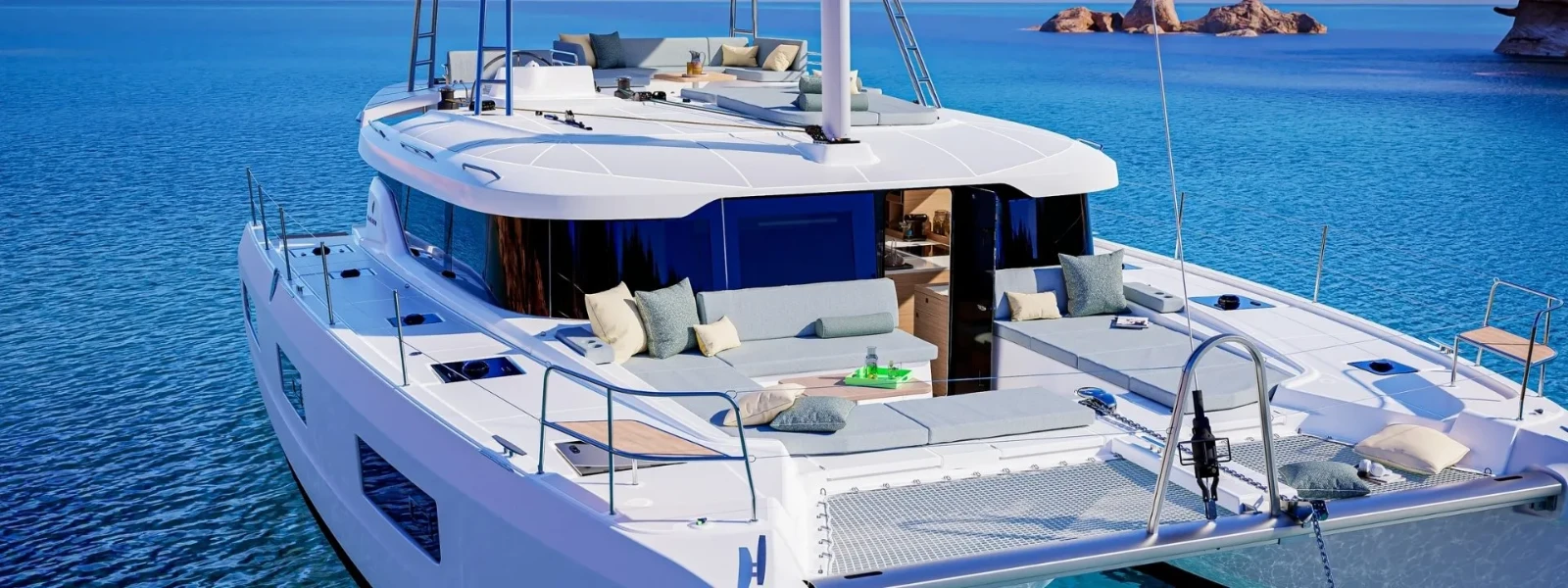
Say you book a Lagoon 46 for a July week at €9,500. You’d send roughly €4,750 at confirmation in, say, February, then the second €4,750 in early June. Simple, predictable, and easy to plan around. The catch is concentration: half the cost lands in one go at booking, which stings if you’re reserving a peak slot eight months ahead.
Rule of thumb: the earlier you book, the longer your deposit sits with the operator before you ever step aboard — so read the cancellation terms before you celebrate the early-bird discount.

The 25/25/50 plan: smaller first bite, balance loaded at the end
Some operators, and most charter agencies handling early reservations, prefer thirds-style staging. A quarter on confirmation, a second quarter a few months later, and the final half before departure. The appeal is obvious for anyone booking in autumn for next summer: you commit a smaller sum now and keep the bulk of your money working until closer to the trip.
On that same €9,500 Lagoon 46, a 25/25/50 plan means about €2,375 in November, another €2,375 around February, and €4,750 in early June. The total is identical — what changes is your cash flow and, crucially, your exposure if you cancel after the first instalment but before the boat is anything close to sold-out season.
When you’ll see 25/25/50 most
It shows up most for bookings made far in advance, on premium new boats, and through brokers who want to secure your commitment without asking for half a charter fee a year out. If you’re planning that far ahead, our look at how far in advance to book a charter, with real data pairs well with the staged-payment approach.
50/50 vs 25/25/50: which protects your cash better
Neither plan is cheaper. The charter fee is the charter fee. What differs is when the money leaves and how much is at stake at each step.
- Cash flow: 25/25/50 keeps more of your money liquid for longer. If you’re juggling other deposits — flights, a villa for non-sailing friends — the gentler first instalment helps.
- Cancellation exposure: this is the real difference. Most operators treat the first deposit as non-refundable once paid, on either plan. But a 25% first payment is a smaller sum to write off than a 50% one if a job, a baby, or a border closes your plans before the balance is due.
- Simplicity: 50/50 is two dates to remember. 25/25/50 is three. For some people that extra reminder is friction; for others, the smaller bites are worth it.
Where cancellation policy actually bites
Payment timing and cancellation terms are joined at the hip. A typical Mediterranean cancellation ladder looks like this: cancel more than 60 days out and you usually lose the deposit only; between 60 and 30 days you forfeit around half; inside 30 days, often the full charter fee unless the boat is re-let.
That’s why the schedule matters beyond cash flow. On a 50/50 plan, your balance falls due right at the 30-day cliff — pay it and you’re effectively all-in. On 25/25/50, you’ve still only committed half by that point in some structures, though many operators load the final 50% at the same 30-day mark, so check the exact dates rather than assuming. The honest move is to ask, in writing, two things: what’s refundable at each stage, and whether they’ll re-let and refund if you cancel late. Many will, quietly, if the boat resells.
Travel insurance changes the maths
A cancellation-and-curtailment policy that names yacht charter as a covered cost turns a scary forfeit into a claim. It typically runs 4–7% of the trip value and is worth it on a five-figure booking. It doesn’t change your payment schedule, but it changes what a missed schedule costs you.
Reading a quote like a broker
When two offers for the same boat show different totals, the schedule is often where the difference hides. One quote bundles the cleaning and tourist tax into the charter fee; another lists them as locally-paid extras, making its headline look lower. Compare the all-in number first, then the payment dates underneath it. If you’re trying to keep the bill down as well as understand it, our guide to money-saving charter tactics for 2026 pairs well with reading a payment plan carefully.
One more thing crews learn the hard way: confirm exactly what you owe at the base and how. Some charter companies still want the security deposit in cash or a separate card pre-authorisation, not folded into your online payment. Turning up expecting one charge and meeting another is a poor start to a week afloat.
Practical timeline for a summer 2027 booking
Here’s how a real schedule tends to play out for a peak-July catamaran reserved the previous autumn, so you can see the rhythm:
- October–November: first instalment paid (50% on a standard plan, or 25% on a staged one). Boat is yours.
- February–March: on a 25/25/50 plan, the second 25% falls due. Nothing happens yet on a 50/50.
- Early June (≈30 days out): the balance is due on both plans. Last realistic point to cancel with partial recovery.
- Check-in day: obligatory extras paid locally; security deposit blocked or waiver fee paid.
- A few days after return: security deposit released, assuming no damage.
If you’re hunting an early-bird rate, the 2027 early-booking deadlines by destination often dictate which schedule you’re offered — the deepest discounts tend to ask for the standard 50% up front.
Frequently Asked Questions
Is the security deposit part of the 50/50 or 25/25/50 schedule?
No. The payment schedule covers only the charter fee. The security deposit is separate — typically €2,000–4,000 blocked on a card at check-in and refunded a few days after a clean return, or replaced by a daily damage-waiver fee if you’d rather not tie up the cash.
Can I pay the full charter fee in one go to get a discount?
Often, yes. Some operators shave 1–3% for full prepayment, and many early-booking offers effectively require the larger first instalment anyway. Just weigh the saving against tying up the money and the cancellation risk — full prepayment doesn’t make the booking any more refundable.
What happens to my deposit if I cancel after the first instalment?
The first instalment is usually non-refundable on either plan. Beyond that, most Mediterranean operators apply a sliding scale: more is recoverable the further out you cancel. Many will refund late cancellations if they re-let the boat, so it pays to ask in writing whether they’ll resell and return your money.
Why does one website show a different payment schedule than another for the same boat?
Agencies and operators set their own deposit terms, and some build obligatory extras into the charter fee while others list them locally. The boat is identical; the schedule and the all-in total can differ. Compare the final number and the payment dates side by side before choosing.
When is the balance usually due?
Most commonly 30 days before check-in, sometimes 45. On a 50/50 plan that’s your second and final payment; on a 25/25/50 plan the final 50% typically lands at the same point. Mark the date — miss it and many operators treat the booking as cancelled.
Ready to see how the schedule looks on a specific boat? Browse live charter availability across the Mediterranean and check the payment terms on any offer before you commit — or read how Boat4You works if you’d rather understand the booking flow first.
Explore boats
Boats you can charter in the places this article covers.
Ideas for your next sailing vacation
Boat rental & yacht charter around the world at the best prices